Zero liquid discharge: From VMLD to ZLD, and the solar step
Brine disposal is costly and polluting; a staged path from minimal to zero liquid discharge recovers water and salt while cutting thermal energy.
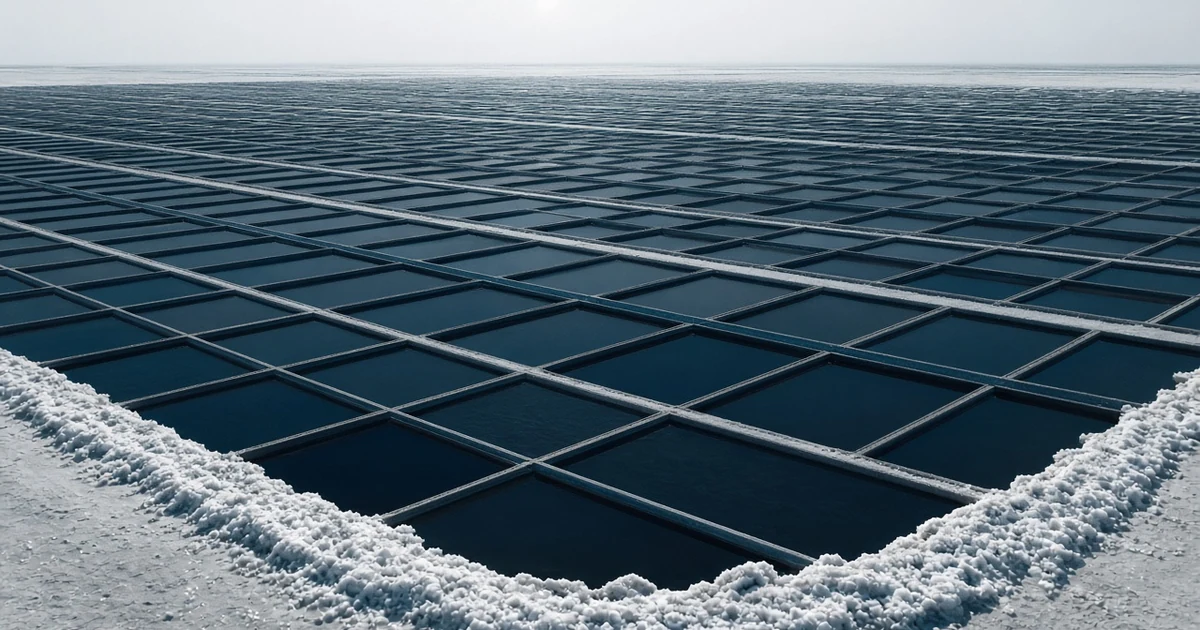
Desalination discharges 141.5 million m³ of brine a day
Desalination plants worldwide produce 141.5 million m³/day of brine (Jones et al., 2019). That is about 1.5× the 95.37 million m³/day of fresh water they make.
The same study concludes that brine disposal is costly and carries negative environmental impacts (Jones et al., 2019). Zero liquid discharge (ZLD) is the end point regulators and operators aim for: no liquid leaves the site.
Conventional RO stops when osmotic pressure wins, which is the reason ZLD is expensive (MediSun membrane portfolio film). Heat has done the remaining work. That is where the cost sits.
Zero liquid discharge is reached in four steps
Liquid discharge targets form a ladder. Each rung removes more water from the brine and leaves less for disposal. The exact thresholds for each rung vary by regulator and plant.
- MLD, minimal liquid discharge, recovers most of the water with membranes and sends a reduced brine stream to disposal.
- VMLD, very minimal liquid discharge, pushes membrane concentration further, so only a small, highly concentrated stream remains.
- Recovery turns the salts in that stream into products, such as acid and alkali from bipolar membrane electrodialysis (BPED), or magnesium carbonate from brine with WEGen Green.
- ZLD evaporates or crystallises the final residue, so no liquid leaves the site.
The order matters. Membranes remove water at far lower energy than heat. Every cubic metre removed before the thermal stage is a cubic metre the evaporator does not boil.
The numbers that set the scale and the membrane steps
These figures frame the brine problem and the membrane steps that shrink it before evaporation.
- 141.5 million m³/day of brine produced worldwide, about 50% higher than earlier estimates (Jones et al., 2019).
- 55% of global brine production comes from Saudi Arabia, the UAE, Kuwait and Qatar (Jones et al., 2019).
- 150 g/L brine concentration reached by MediSun high-salinity RO (HSRO), doing the work of disc-tube RO without its maintenance burden (MediSun membrane portfolio film).
- 160–200 g/L concentrate from MediSun ED concentration stacks (MS-EDC).
- Up to 99% less toxic wastewater discharge with BPED in suitable applications; indicative, dependent on feed, recovery target and configuration, and confirmed at pilot stage.
Interfacial solar evaporation replaces the pond and the boiler
The last step is the hardest. Two options dominate today. Evaporation ponds take land and can leak into aquifers. Thermal ZLD needs high energy and capital (MediSun BrineHouse film).
Interfacial solar evaporation offers a third option. It works on a different principle from a pond.
Surface heating. A pond lets sunlight warm the whole water body. An interfacial evaporator absorbs sunlight in a thin layer at the water surface.
Concentrated heat. The heat stays where evaporation happens. Less energy is lost warming water that never evaporates.
Compact footprint. Because the surface works harder, the evaporator needs less area than a pond for the same task.
Salt handling. The final concentrate leaves salt behind on or near the evaporator, which is collected instead of left in a lined basin.
MediSun BrineHouse uses compact interfacial solar evaporators to treat the final concentrate in place of ponds (MediSun BrineHouse film). Upstream, high-salinity RO and BPED shrink the stream first. The train pushes a BWRO plant from VMLD towards zero liquid discharge.
Where the ladder matters, and where it stands today
The ladder matters most where brine has no easy exit.
- Inland BWRO plants in the Gulf interior and Southeast Asian river basins, which have no marine outfall.
- Industrial ZLD sites in chemicals, mining and battery materials, where salt can become product.
- Gulf desalination operators, which carry most of the world’s brine.
The membrane steps are commercial today. MediSun HSRO, electrodialysis and BPED each have commercial deployment records. BrineHouse joins them with solar evaporation into one train. It is moving from engineering design to a full-process demonstration line.
Every rung climbed is water returned and land spared. Decentralised plants cannot multiply if each one leaves a pond behind.
Zero liquid discharge is how water production stops borrowing from the future.
Next step: See how the full train fits onto an existing plant in BrineHouse: BWRO brine treatment that recovers the water.