BrineHouse: BWRO brine treatment that recovers the water
Inland BWRO plants store or truck their reject; BrineHouse intercepts it at source and returns water and chemicals to the plant.
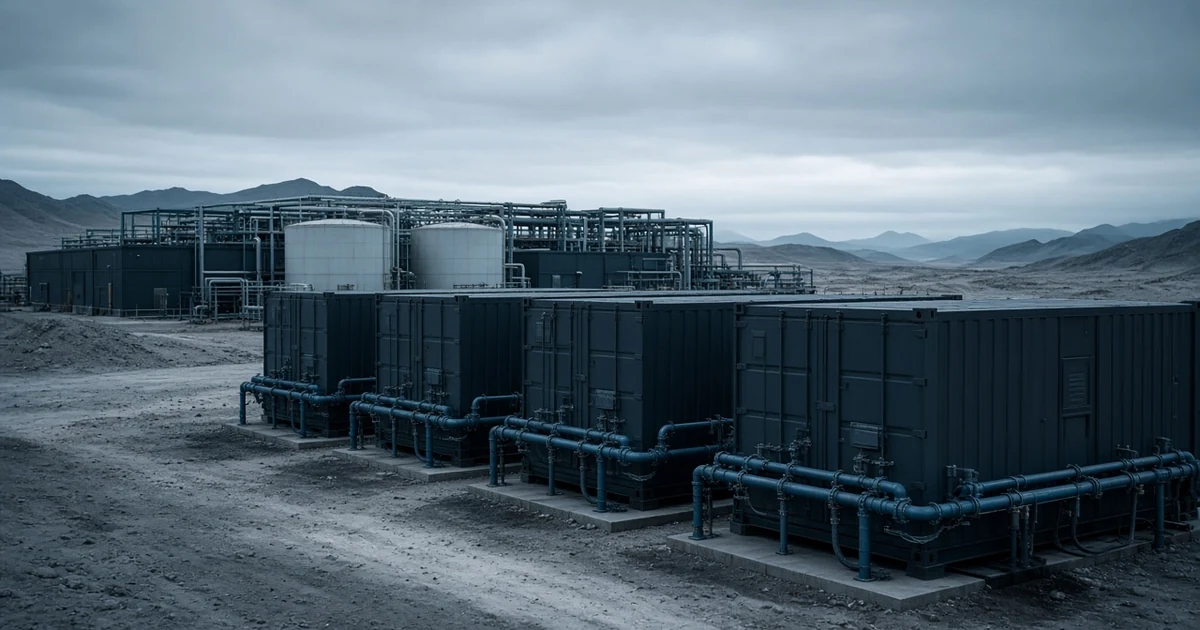
Every brackish plant carries a hidden brine cost
Desalination plants worldwide produce 141.5 million m³/day of brine, about 1.5× the fresh water they make (Jones et al., 2019).
Every drop of fresh water made from brackish sources carries that hidden cost (MediSun BrineHouse film). BWRO leaves a hyper-concentrated reject. Inland plants often have no marine outfall.
So the reject sits in brine ponds that take land and can leak into aquifers. Or it travels by truck, a recurring cost. Thermal zero liquid discharge (ZLD) needs high energy and capital. BWRO brine treatment at the source offers a fourth route.
BrineHouse treats BWRO brine in five linked stages
BrineHouse is plug-and-play, modular and prefabricated. It locks into an existing BWRO plant and intercepts the reject at the source (MediSun BrineHouse film). Brine management moves from the edge of the site into the process itself.
- Pretreatment, including MediSun graphene ultrafiltration (GUF), clears the reject stream of solids and organics.
- BrineCore™ electrodialysis metathesis (EDM) concentrates the brine, strips scaling ions and returns a clean, low-scaling stream to the BWRO to recover more water.
- Hypercon™ high-salinity RO and OsmoPress™ pressurised forward osmosis hyper-concentrate the remaining salts.
- BPED bipolar membrane electrodialysis regenerates hydrochloric acid and sodium hydroxide, which route back into the plant.
- Evaporators, compact and interfacial-solar, treat the final concentrate in place of ponds.
An AI core monitors and optimises the system and runs it unmanned (MediSun BrineHouse film).
Each stage inherits what the stage before failed to remove (MediSun membrane portfolio film). The return loop matters most. A low-scaling stream lets the original BWRO recover more water from the same feed.
The stages also close a chemical loop. BPED turns waste salt into the hydrochloric acid and sodium hydroxide the plant would otherwise buy. Solar evaporators then replace the pond, so the site gives up less land to brine.
The numbers behind the brine and the components
BrineHouse performance figures will be published when the demonstration line reports. The figures below describe the scale of the problem and the commercial components inside the train.
- 141.5 million m³/day of brine produced by desalination worldwide, about 50% higher than earlier estimates (Jones et al., 2019).
- 55% of global brine production comes from Saudi Arabia, the UAE, Kuwait and Qatar (Jones et al., 2019).
- ≤73 g/L HCl and ≤80 g/L NaOH from MediSun three-compartment BPED stacks, standalone catalogue rating.
- pH 0–14 operating range for MediSun AEM, CEM and bipolar membranes, with a 3–5 year membrane service life.
- 0.02 µm absolute barrier on MediSun GUF, with 51 m² of active area in a 225 mm module (MediSun membrane portfolio film).
Where BWRO brine treatment pays first
BrineHouse targets plants where the brine has nowhere easy to go.
Inland municipal BWRO. Towns on brackish groundwater in the Gulf interior run plants far from any sea. Their reject now fills ponds or tankers.
Industrial process water. Mines, chemical plants and food processors run BWRO for supply. They also buy acid and caustic, which BPED can regenerate on site.
Industrial parks in Southeast Asia. Parks that discharge to rivers need a route for concentrated salt that does not end in the river.
Existing plants, not new builds. BrineHouse locks into an existing BWRO plant. Owners can add brine treatment without rebuilding the front end.
Plants under discharge pressure. Sites facing tighter permits or rising pond and haulage costs gain a route that does not depend on new land.
The system pushes plants from VMLD towards zero liquid discharge (MediSun BrineHouse film). It advances UN Sustainable Development Goals 6, 9 and 12.
From engineering design to a demonstration line
BrineHouse is not yet a commercial product. The integrated system is moving from engineering design to a full-process demonstration line (MediSun BrineHouse film).
Its core components are not new. Electrodialysis, high-salinity RO and BPED each have commercial deployment records. The demonstration line proves them as one train on one BWRO plant.
The membranes inside the train are MediSun’s own. Inside every MediSun machine, the membranes and polymeric heat exchangers are the layer MediSun makes itself (MediSun master film).
Plant owners can engage now to scope a site for later deployment. Scoping starts with the existing BWRO plant, its reject stream and its current disposal route.
Decentralised water will spread inland only when each plant closes its own loop.
The next era of water leaves no brine behind.
Next step: To discuss scoping BrineHouse for an existing BWRO plant, contact info@medisun.energy.