Island water supply: Desalination where the mainland grid ends
Islands sit in seawater yet import their water by pipe, ship or rain; compact desalination makes island water supply a local product.
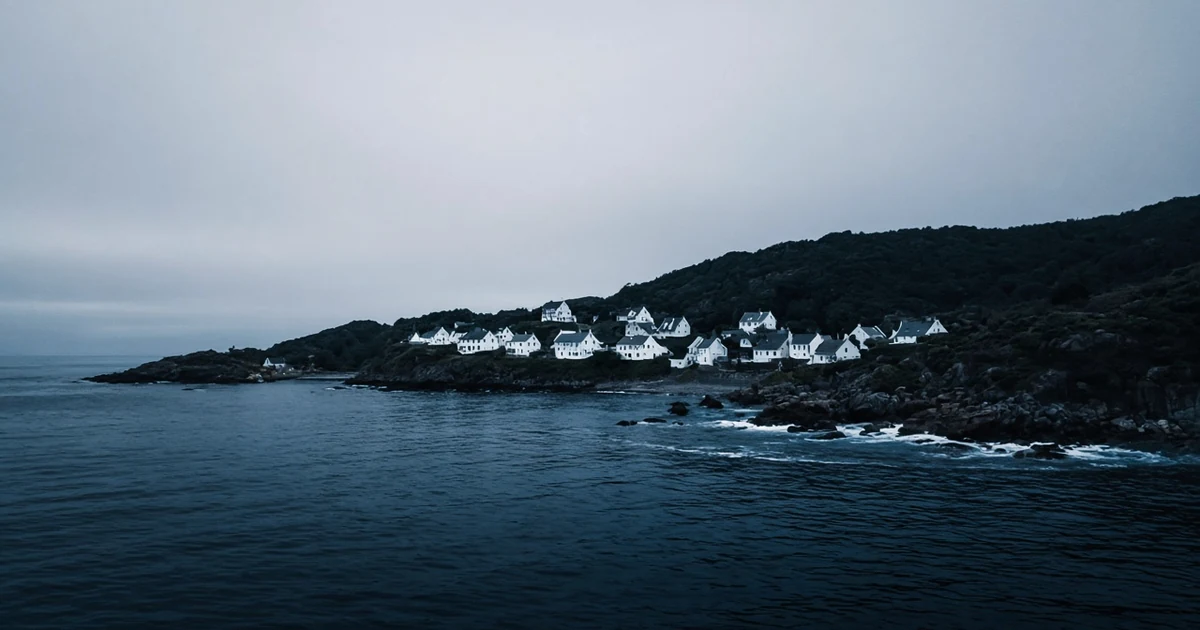
Desalination capacity sits in large plants, far from small islands
The world runs 15,906 operational desalination plants, producing 95.37 million m³/day of water (Jones et al., 2019). That capacity serves the networks it was built for.
Island water supply works differently. A small island cannot connect to a mainland plant without a subsea pipe or a ship. Many islands depend on rainwater, shallow wells or delivered water.
The irony is plain. These communities are surrounded by seawater. The water source is already there; the production is not.
The centralised grid stops at the shoreline
MediSun describes two models of water supply (MediSun master film).
The centralised grid uses one source and pushes water outward. Everything downstream is at risk when that source or its pipes fail. Each kilometre of pipe adds cost and leakage.
The point-of-service grid places production where water is used. It runs as hundreds of independent nodes. A failure at one node stays at that node.
Islands show the limit of the first model most clearly. The pipe has to cross open water. The ship has to cross weather. Each crossing is a single point of failure.
How island water supply moves on-site, in four steps
The argument for local production runs in four steps.
- Distance adds loss, and 47 Southeast Asian utilities lost 4% to 65% of water produced as non-revenue water (World Bank, 2006).
- Islands add a second crossing, because a subsea pipe or a supply ship must reach the shore before any network begins.
- Seawater is the one resource every island already holds, at the shoreline and in constant supply.
- Compact desalination turns that seawater into drinking water beside the point of use, so the crossing disappears.
The thesis is not that big plants are wrong. Large plants serve dense mainland cities well. The thesis is that the last island should not wait for the last pipe.
Small units match small island demand
An island node must match the scale of the community it serves. The figures below come from field data and the product catalogue.
- Network loss: IBNET utilities report average non-revenue water of around 35%; the authors estimate the true average is probably 40–50% of water produced (World Bank, 2006).
- VASAR output: 1,200 L/day, or 60 people/day at 20 L/person/day basic access.
- VASAR Pro output: 9,600 L/day, or 480 people/day at 20 L/person/day basic access.
- Field energy: 3.5 kWh/m³ on 33,600 mg/L TDS seawater, measured on site across the Dapeng pilot (MediSun VASAR Catalogue V4; MediSun VASAR film).
Units scale by number. Several units serve a larger village, and a failure of one unit leaves the others running.
Larger island towns need more capacity. The WaterHouse line lists small towns and islands among its applications, and WaterCube (WaterCube: A containerised water treatment plant that moves) modules start from a baseline of 500 m³/day.
The units also move without heavy plant. VASAR weighs 40 kg, a two-person lift. VASAR Pro weighs 255 kg, rolls on casters and fits a standard doorway.
Fishing villages, atolls and research stations come first
VASAR’s coastal deployment front covers fishing villages, islands and atolls. These communities share three conditions: seawater at the door, no mainland pipe and long supply lines.
The first field reference is a coastal one. The Dapeng Coral Conservation Station in Shenzhen had no municipal water connection. It relied on rainwater and trucked water. VASAR now desalinates its seawater on a standard single-phase line (Dapeng: A seawater desalination case study at a coral station). Station demand peaks at 3,000 L/day during intensive diving operations. A single VASAR Pro, rated at 9,600 L/day, sits above that peak.
Southeast Asia and the Gulf both hold island and coastal communities beyond the mainland network.
Water and energy both move onto the island
Islands often import energy as well as water. The next step addresses both.
On 3 Aug 2026, at DRT SHOW Chengdu, MediSun and JA signed an ecosystem MoU to build zero-carbon water systems for islands and coastal environments (press release). JA provides PV, battery storage and green power. MediSun provides compact VASAR desalination.
The status is plain. VASAR and VASAR Pro are available today on a standard power connection. One seawater pilot has produced field data. Its measured 3.5 kWh/m³ sets the load a future solar and storage system must meet. Solar plus storage is a roadmap configuration under an MoU, not a shipped product.
The mainland grid ends at the shore. Island water does not have to.
The next era of water will not be built bigger. It will be built everywhere.
Next step: To scope an island or coastal deployment, email info@medisun.energy.