Dapeng: A seawater desalination case study at a coral station
A coral research base with no mains water ran on rain and trucks; VASAR now desalinates its seawater on site on a single-phase line.
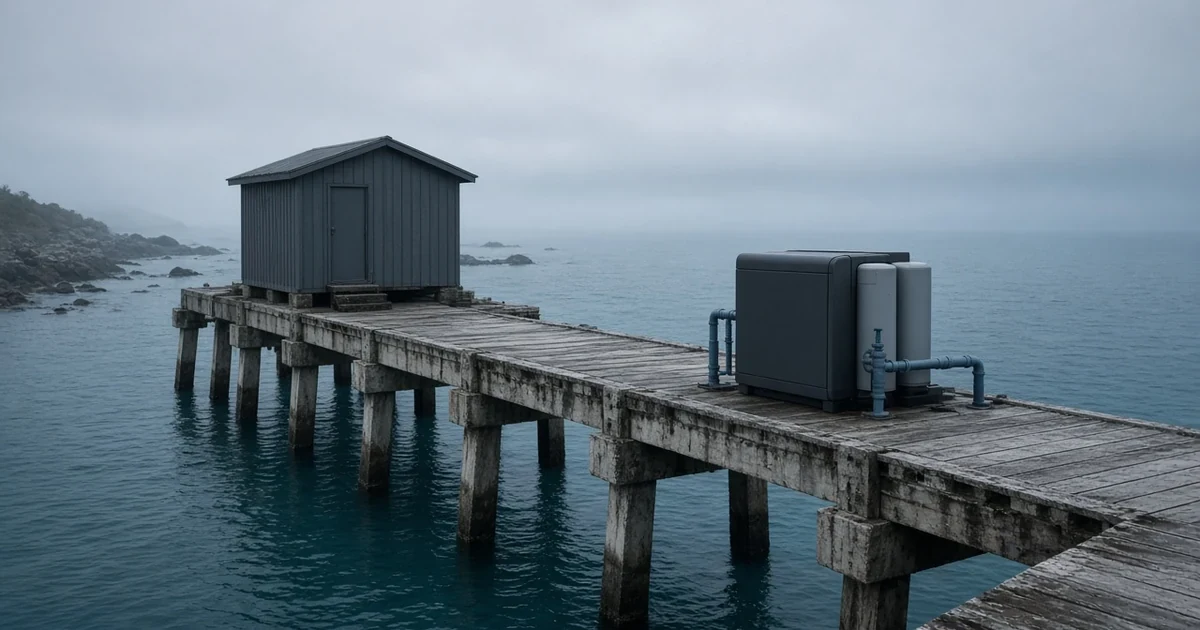
Coastal sites sit beside the ocean and still truck their water
Desalination plants worldwide produce 95.37 million m³/day of water across 15,906 operational plants (Jones et al., 2019).
Small coastal sites sit outside that system. A research station, a fishing village or an island post can stand metres from the sea and still wait for a water truck.
This seawater desalination case study follows one such site and its remote water supply. It records what changed when the treatment moved to the point of use.
This seawater desalination case study starts without mains water
The Dapeng Coral Conservation Station in Shenzhen is a marine research base. It had no connection to the municipal water network.
The station relied on two sources. It collected rainwater, and it brought in water by truck. Rainfall varies by season. Trucks cost money on every trip and depend on road access.
Demand is not steady either. Water use peaks at 3,000 L/day during intensive diving operations. The peaks arrive when research is busiest.
Any treatment system also had to run on the power the site already had.
How the seawater desalination ran on site
MediSun deployed VASAR, its compact desalination unit, at the station. The unit draws seawater directly and runs the full treatment train in one frame.
- Intake draws seawater at 33,600 mg/L total dissolved solids (TDS).
- Ultrafiltration removes solids and organics, and backwash keeps the immersed modules clean.
- Reverse osmosis rejects more than 99% of the salt under pressure from a high-pressure pump.
- Energy recovery returns pressure from the reject stream to the feed.
- Polishing passes the water through KDF media, UV disinfection and mineralisation before use.
The unit ran on a standard single-phase line. A visualisation window shows a live process schematic and diagnoses faults stage by stage. Station staff can see which stage needs attention without a specialist on site.
The pilot measured 3.5 kWh/m³ and 210 mg/L product water
The field results came from the station itself, not from a laboratory.
- Feed salinity: 33,600 mg/L TDS seawater at intake (MediSun VASAR Catalogue V4; MediSun VASAR film).
- Product water: 210 mg/L TDS.
- Salt rejection: more than 99%.
- Specific energy: 3.5 kWh/m³, measured on site across the pilot (MediSun VASAR Catalogue V4; MediSun VASAR film).
- Power supply: standard single-phase line; VASAR connected load 0.6 kW.
Specific energy matters most for remote sites. Every kilowatt-hour has to come from a local generator, a weak line or, in future, a solar array. A measured figure lets an engineer size that supply.
The station’s demand peak of 3,000 L/day exceeds one VASAR unit’s 1,200 L/day rating. Peak coverage therefore depends on storage or a larger unit. A VASAR Pro produces 9,600 L/day at 2.8 kW connected load.
The result applies to every site beyond the mains
The Dapeng case maps coastal desalination onto a defined set of sites. Each one has seawater or brackish water nearby and no mains connection.
Marine research and conservation stations share Dapeng’s profile directly. Fishing villages, islands and atolls share the same supply problem at a larger scale. Coastal resorts and remote ports face the same truck dependence.
Basic-access arithmetic sets the scale. At 20 L/person/day, one VASAR serves 60 people/day and one VASAR Pro serves 480 people/day.
The single-phase result widens the field. A single-phase desalination unit fits sites without an industrial power supply.
The desert front differs in feed water. Brackish groundwater carries less salt than seawater, so the same train faces a lighter load.
From pilot to the next coastline
The Dapeng deployment is a pilot. It produced measured field data on real seawater at a working research base. VASAR and VASAR Pro are offered for coastal and desert sites on a standard power connection. VASAR weighs 40 kg, a two-person lift, so it reaches sites that a crane cannot.
Solar and battery operation is a separate step. It is a roadmap configuration, not yet a shipped product. The 3.5 kWh/m³ figure gives the baseline for sizing that future system.
One small station proved a simple point. A coastline can make its own water.
Water production belongs where people use it.
Next step: Read how the 3.5 kWh/m³ baseline shapes the solar roadmap in Solar powered desalination: the roadmap to zero-carbon water.