WaterCube: A containerised water treatment plant that moves
Water demand outruns plant construction in towns and industrial sites; WaterCube ships a tested treatment plant from the factory and moves when demand moves.
Freshwater demand will exceed supply by 40% by 2030
Global freshwater demand is predicted to exceed supply by 40% by 2030 (World Economic Forum, 2023).
The gap opens first where networks are thin. Small towns, islands, industrial parks and construction camps sit far from the nearest large plant.
A conventional water treatment plant answers slowly. It needs land, foundations, concrete tanks and a long construction programme before it delivers a litre.
A containerised water treatment plant changes the order of work. The plant is built and tested in a factory, then shipped to site. The owner gets capacity while a concrete plant would still be in design.
WaterHouse is one product line with two tiers
MediSun builds its drinking-water plants under one product line, WaterHouse. The line has two members: WaterCube and i-WaterHub.
Both are factory-built, pre-assembled and commissioned before shipment. Both treat brackish water or seawater.
WaterCube is a modular water treatment plant that scales by adding modules and relocates when a project ends. i-WaterHub is the premium tier, managed by the AquaX Robot® AI operations platform. The next post, i-WaterHub: an autonomous water treatment plant, covers it in full. This post covers WaterCube.
A containerised water treatment plant runs four stages from feed to tap
WaterCube follows the WaterHouse four-stage process. Every module is piped, wired, pressure-tested and factory acceptance tested in the MediSun factory before shipment.
- Ultrafiltration removes microorganisms and turbidity through 0.01 µm pores and protects the RO membranes downstream.
- Reverse osmosis removes up to 99% of dissolved salts, heavy metals and organics from the brackish feed.
- Remineralisation stabilises the permeate and reduces its corrosivity before it enters the network.
- UV disinfection treats the product water at a dose of at least 40 mJ/cm².
The output meets the WHO drinking-water standard. One brackish water reverse osmosis design covers feed water from 1,000 to 8,000 mg/L, so a single plant type serves a wide range of brackish wells and rivers.
WaterCube delivers 6,000 m³/day in about 500–550 m²
The figures below come from MediSun product documents. Each carries its basis.
- Capacity: the standard system delivers 6 MLD (6,000 m³/day) from two independent 3 MLD modules; systems are sized from a baseline of 0.5 MLD (500 m³/day).
- Recovery: up to 70% of the feed water leaves as product water.
- Energy: 1.0–1.5 kWh per m³ of product water.
- Footprint: a full 6 MLD system fits in about 500–550 m²; the WaterHouse line cuts footprint by 67% against traditional design.
- Delivery: 3–6 months for manufacturing, shipping and installation, then commissioning in 1–2 weeks.
A 6 MLD system is priced at US$3.5 million, under US$600 per m³/day of capacity, complete, tested and commissioned.
Independent modules let one plant follow the demand
Each WaterCube module has its own controls and its own power connection. One module can be removed and moved to a new site while the other keeps running.
Cleaning-in-place runs on one module at a time, so the plant keeps producing during maintenance. One remineralisation stage serves both modules.
Modules move by truck, rail or vessel. Installation needs only basic site levelling and pipe and power connections.
Operators run and monitor the plant remotely through WaterOS, from a PC, pad or phone. Integrated SCADA and PLCs send SMS and email alarms. Variable frequency drives cut power when demand falls.
WaterCube serves five segments:
- Municipal supply for small towns and islands at the edge of the network.
- Industrial process water for industrial parks and plants on brackish wells.
- Cooling towers that need steady make-up water.
- Irrigation where groundwater is too saline for crops.
- Construction camps that need water for the life of a project, then move.
The Gulf and Southeast Asia share these conditions. New towns and industrial zones appear faster than trunk mains extend. A decentralised water supply reaches them without waiting for the network.
Sites that need sewage treatment as well can pair WaterCube with RECLAR, the containerised sewage treatment plant, which applies the same factory logic to wastewater.
Factory-built drinking water ships in months
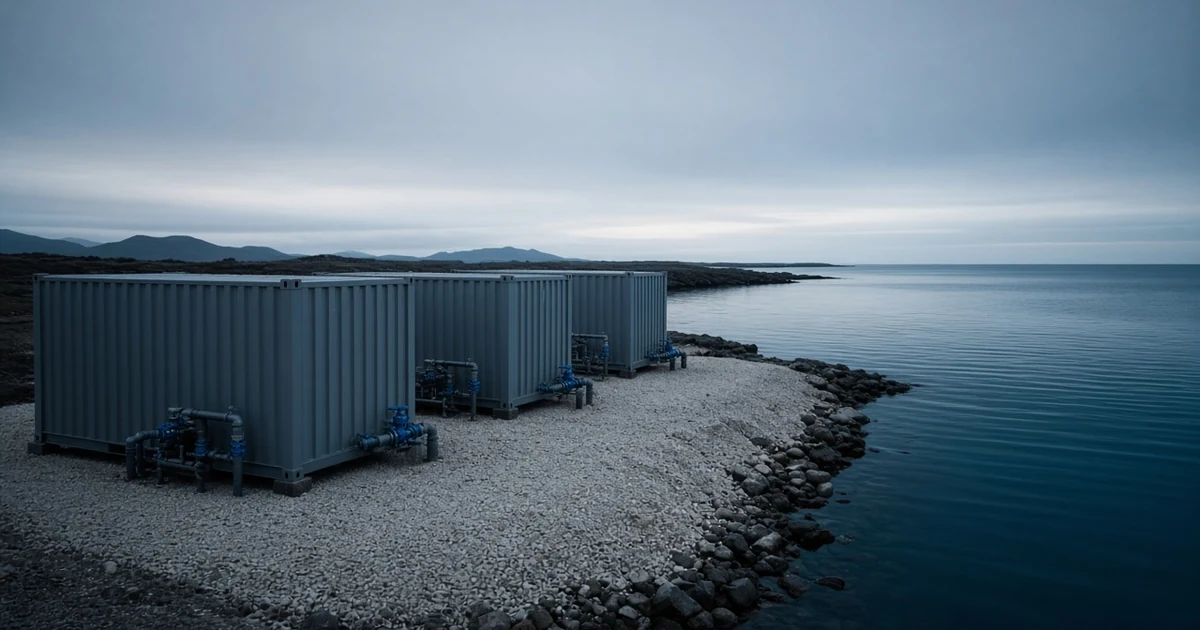
WaterCube is a factory-built system in the WaterHouse catalogue.
The factory model moves risk off site. The plant arrives tested, connects in weeks and leaves when the project ends. An owner buys water capacity that can follow demand, not a fixed asset tied to one plot.
Water no longer has to wait for the pipe to arrive. It can be produced at the point of use, in hundreds of independent nodes.
The next water network will be built everywhere, one module at a time.
Next step: Send your feed-water analysis and daily demand to info@medisun.energy for a WaterCube sizing proposal.