Global desalination brine production: 141.5 million m³ a day
Desalination plants discharge 1.5 litres of brine for every litre of fresh water; reading the numbers by region shows where the brine problem sits.
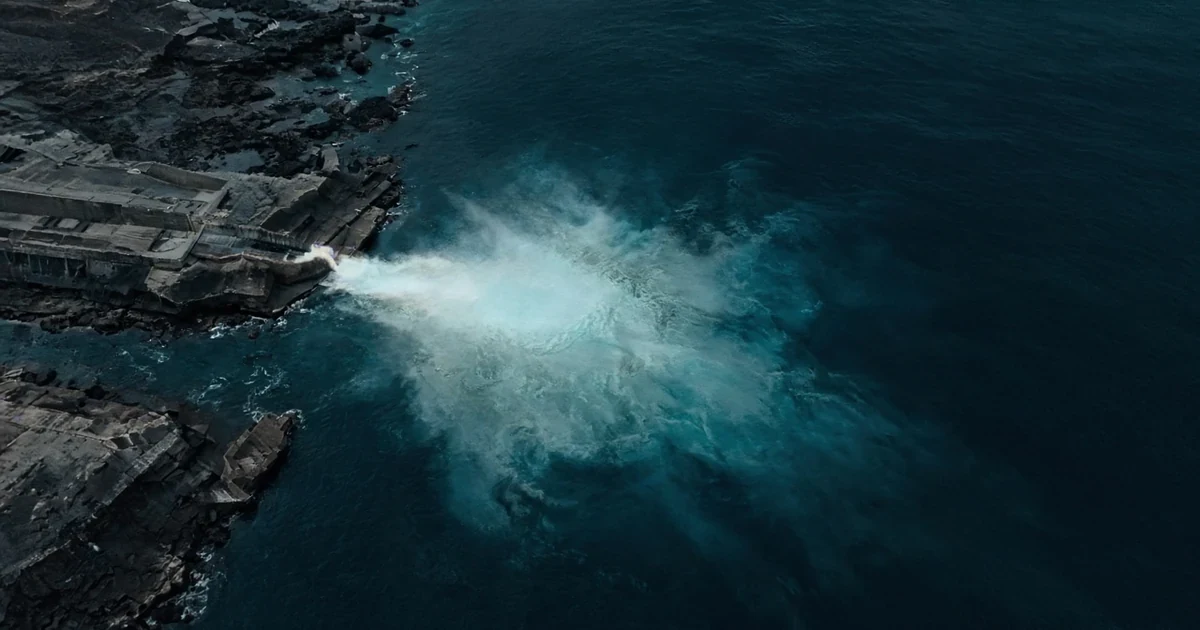
Desalination makes 141.5 million m³ of brine a day
The world’s desalination plants discharge 141.5 million m³/day of brine (Jones et al. 2019). That is about 1.5 times the fresh water they produce. It is also about 50% higher than earlier estimates.
The figure comes from the study of global desalination brine production by Jones and colleagues, published in Science of the Total Environment. It counts 15,906 operational plants. Their combined output is 95.37 million m³/day of desalinated water.
Every one of those plants must put its brine somewhere. The authors conclude that brine disposal is costly and carries negative environmental impacts.
Brine volume follows feed water, technology and region
Brine is the concentrated reject stream left when a plant separates fresh water from saline feed. Its volume depends on how much of the feed the plant recovers as a product.
The study’s headline ratio is about 1.5 m³ of brine for every 1 m³ of desalinated water (Jones et al. 2019). That ratio is a global average across all plants, feeds and technologies. Individual plants vary around it.
Recovery is therefore the lever. A plant that recovers more of its feed as a product sends less brine to disposal for the same output.
The geography is uneven. Production and brine both concentrate in a few countries. Most of them border the Gulf.
How the global brine figure is read
The Jones et al. result moves from plants to regions. It can be read in four steps.
- Count the operational desalination plants worldwide, which the study puts at 15,906.
- Sum their desalinated water output, which comes to 95.37 million m³/day.
- Set brine against that output, which gives 141.5 million m³/day, or about 1.5× the water produced.
- Locate the brine by country, which shows that four Gulf states account for 55% of the global total.
The result sits about 50% above earlier estimates. The paper’s method section sets out the basis; planners should read it before scaling the ratio to a single plant.
Global desalination brine production in five figures
All five figures come from one peer-reviewed source (Jones et al. 2019).
- 15,906 operational desalination plants worldwide.
- 95.37 million m³/day of desalinated water produced worldwide.
- 141.5 million m³/day of brine produced worldwide; about 1.5× the desalinated water output and about 50% above earlier estimates.
- 48% of desalinated water is produced in the Middle East and North Africa.
- 55% of global brine production comes from four countries: Saudi Arabia, the UAE, Kuwait and Qatar.
Where the brine lands: the Gulf and inland plants
The regional split defines the problem. Saudi Arabia, the UAE, Kuwait and Qatar produce 55% of the world’s brine (Jones et al. 2019). For Gulf utilities, brine is now a planning constraint. Outfall design, discharge permits and long-term marine monitoring all scale with volume. New capacity adds new brine at about the global ratio unless plants recover more of their feed.
Inland plants face a different version of the problem. Brackish water reverse osmosis plants often have no marine outfall. Their reject goes to evaporation ponds, trucks or thermal zero liquid discharge, each with its own land, transport or energy cost. MediSun’s BrineHouse film sets out those options.
Southeast Asian programmes are earlier on the curve. Coastal and island desalination is growing there. Each new plant adds to a brine total the region has not yet had to manage at Gulf scale.
Investors read the same figures as risk. A plant’s licence to operate depends on where its brine goes. Projects that plan brine handling at design stage avoid retrofits later. Disposal then stays a design choice, not a recurring surprise in the operating budget.
Brine treatment is moving from disposal to recovery
Brine treatment technologies are at different stages. Electrodialysis, high-salinity reverse osmosis and bipolar electrodialysis already run in commercial plants. Integrated brine recovery trains, including MediSun’s BrineHouse, are moving from engineering design to demonstration.
The components already carry numbers. MediSun HSRO concentrates brine to 150 g/L (MediSun membrane portfolio film). MediSun three-compartment BPED stacks turn waste salt into acid up to 73 g/L HCl and alkali up to 80 g/L NaOH. MediSun WEGen Green turns brine and industrial CO₂ into magnesium carbonate at 95% purity.
The direction is set by the numbers. A sector that makes 1.5 m³ of brine for each m³ of water cannot treat brine as an afterthought. Recovery of water, salts and energy from reject is the next step for desalination.
Fresh water at scale now requires an answer for the brine.
Next step: See how brine becomes a feedstock for water, chemicals, minerals and heat in Water resource recovery: Four cores in every drop.