Water Resource Recovery: Four Cores in Every Drop
Water plants discard brine, salt and pressure as waste; recovering each stream yields water, chemicals, minerals and energy from the same drop.
Desalination leaves 141.5 million m³ of brine a day
Global freshwater demand is predicted to exceed supply by 40% by 2030 (World Economic Forum, 2023). Water resource recovery closes part of that gap by taking more from every stream a plant already handles.
Desalination shows the size of the waste. The world’s plants produce 141.5 million m³/day of brine, about 1.5 times the 95.37 million m³/day of water they make (Jones et al., 2019). The authors conclude that brine disposal is costly and carries negative environmental impacts.
Brine is not empty. It holds salts that industry buys as acid and caustic. It holds magnesium. Its salinity gap can make electricity.
Four cores, three layers: the platform in one drop
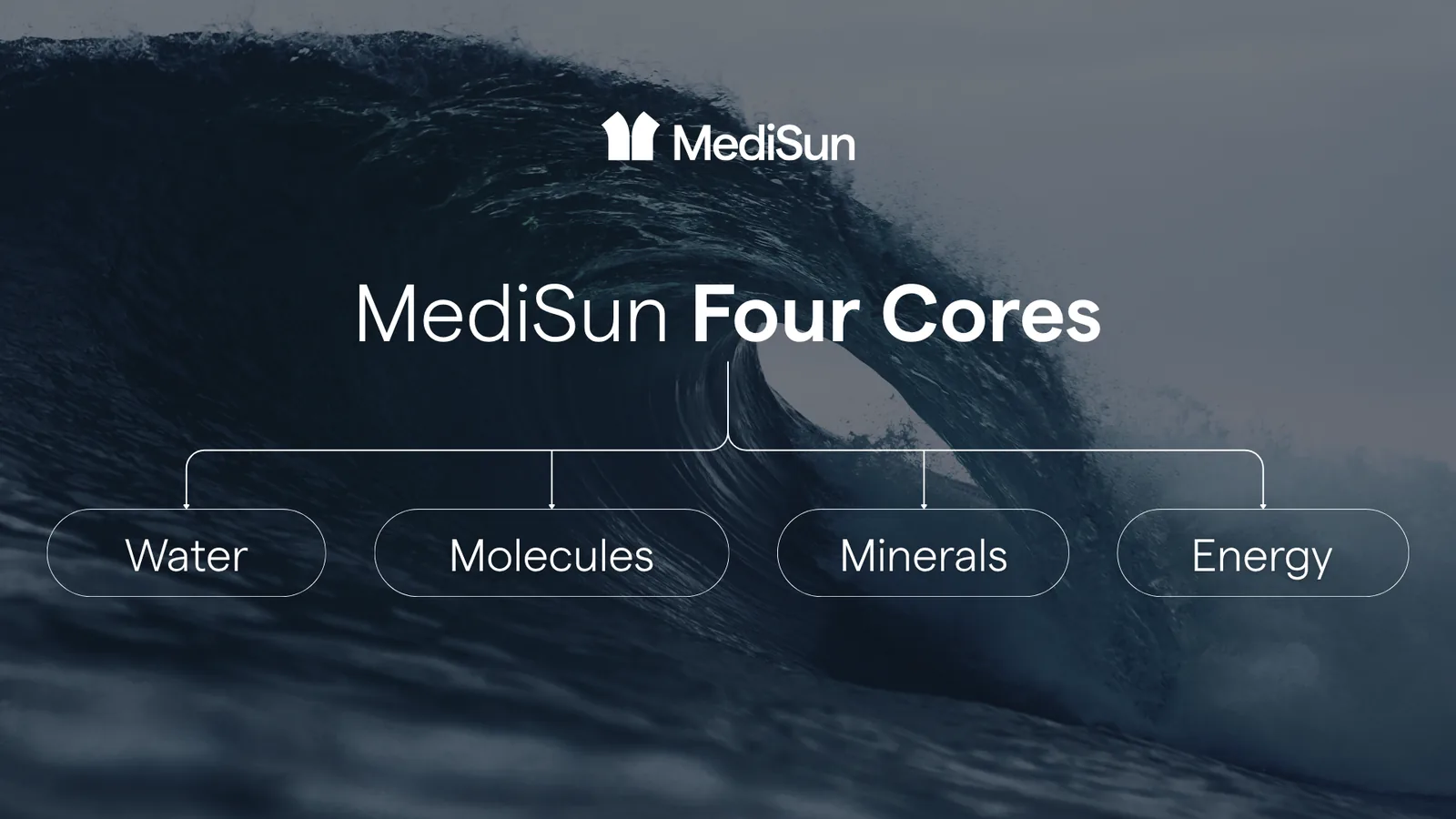
The MediSun master film puts it in one line: “Look inside a single drop of seawater — everything is already there” (MediSun master film). The film names four cores: water, molecules, minerals and energy. MediSun builds one product line for each.
Three layers carry the cores to the reader’s site. First, the node shrinks: VASAR puts desalination in a unit two people can lift. Second, water changes form: HYDAR seals it in bottles where the grid has failed. Third, the technology inside every machine is MediSun’s own: the membranes and the polymeric heat exchangers.
How water resource recovery works, core by core
- Water comes first: the WaterHouse line, WaterCube and i-WaterHub, makes drinking water from brackish water or seawater, and RECLAR treats wastewater in containers.
- Molecules come from waste salt: bipolar electrodialysis (BPED) splits a salt solution into hydrochloric acid and sodium hydroxide.
- Minerals come from brine and carbon: WEGen Green turns desalination brine and industrial CO₂ into magnesium carbonate and magnesium oxide.
- Energy comes from the salinity gap: WEGen uses reverse electrodialysis to build a voltage across ion-exchange membranes.
The water core is modular. WaterCube runs a 6 MLD (6,000 m³/day) standard system as two independent 3 MLD modules. i-WaterHub runs on the AquaX Robot® AI platform with zero on-site staff.
The molecules core turns a disposal cost into a chemical supply. Inside BrineHouse, BPED regenerates acid and caustic that route back into the plant.
The minerals core starts with sodium hydroxide. NaOH precipitates magnesium hydroxide from brine; injected CO₂ converts it to hydromagnesite, which dries into MgCO₃ or MgO.
The energy core retrofits an SWRO plant. At the intake, WEGen lowers feed salinity; on the reject line, it levels brine (example: 50,000 ppm) to seawater salinity (35,000 ppm) before discharge.
The numbers for each core
- Water: WaterCube uses 1.0–1.5 kWh/m³ with recovery up to 70%, on feed water of 1,000–8,000 mg/L.
- Molecules: three-compartment BPED stacks produce acid to ≤73 g/L HCl and alkali to ≤80 g/L NaOH, with 50–200 membrane pairs per stack.
- Minerals: WEGen Green recovers 95% of the magnesium at 95% MgCO₃ purity, yielding 8–17 kg MgCO₃ per tonne of brine, depending on water quality.
- Energy: WEGen generates up to 2.9 kWh per stack and cuts SWRO specific energy consumption by up to 30%.
- Smaller node: VASAR makes 1,200 L/day and VASAR Pro 9,600 L/day.
Where each core pays first
Recovery pays first where a plant both discards a stream and buys what that stream contains. Gulf seawater plants fit the energy and minerals cores. Saudi Arabia, the UAE, Kuwait and Qatar account for 55% of global brine production (Jones et al., 2019). WEGen cuts their intake energy, and WEGen Green turns their reject into a mineral product.
Inland brackish plants fit the water and molecules cores. They often have no marine outfall, so trucking and ponds carry a recurring cost. Chemical plants that buy acid and caustic fit BPED.
Towns, islands, mining sites and military bases fit the WaterHouse line. Flood zones fit HYDAR, which fills 1,600 bottles of 18.9 L a day. Breweries and food plants already run P-HEX (MediSun P-HEX film).
Water and molecules ship today; minerals and energy run as a pilot
The water core is commercial. MediSun has delivered over 10,000 decentralised wastewater units of 30–200 m³/day. The molecules core is commercial at component level: BPED runs a 10,000 t/a lithium hydroxide line. BrineHouse is at engineering-design stage, moving to a full-process demonstration line.
The minerals and energy cores run together in Project Elixir with EMSTEEL in Abu Dhabi. A WEGen RED system treats 500 m³/day of brine, and a WEGen Green pilot processes 30 m³/day (PR Newswire, 2025).
VASAR ships in two models. HYDAR is built and operating. A water plant built on the four cores stops being a disposal site and becomes a recovery site, wherever people need it.
Every drop already holds what the plant needs.
Next step: Read why recovery nodes sit beside large utilities, not against them, in Centralised vs decentralised water: one network, two scales.