Containerised sewage treatment plant: RECLAR ships in months
Towns and industrial parks outgrow their sewers faster than concrete plants can be built; RECLAR ships treatment capacity in containers instead.
Unsafe sanitation contributes to 1.4 million deaths a year
At least 1.4 million deaths in 2019 were attributable to unsafe drinking water, sanitation and hygiene (WHO, 2023).
A conventional sewage treatment plant is a civil works project. It needs land, foundations, concrete tanks and a long construction programme before it treats a single litre.
A containerised sewage treatment plant changes the order of work. The plant is built and tested in a factory, then shipped to site. The town gets treatment capacity while the concrete alternative is still in design.
A containerised sewage treatment plant runs four stages in a steel box
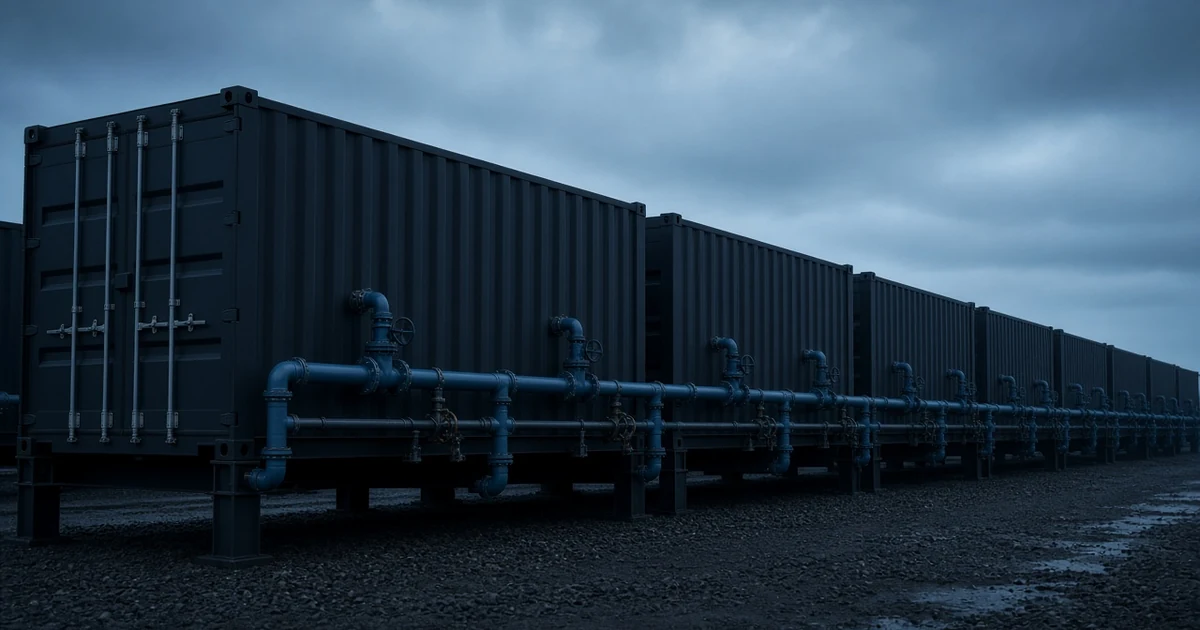
RECLAR puts a complete treatment train inside standard ISO containers. Each stage is pre-wired and pre-tested before it leaves the factory.
- Pretreatment removes screenings and grit, then equalises flow so the biology downstream sees a steady load.
- Biology combines anoxic denitrification with aerobic oxidation of BOD, COD and ammonia, followed by clarification.
- Membranes in a membrane bioreactor separate solids, bacteria and viruses through ultrafiltration at 0.01–0.1 µm.
- Disinfection with a dose such as sodium hypochlorite makes the effluent safe for discharge or reuse.
The membrane bioreactor does two jobs. It produces cleaner effluent than settlement alone, and it produces less sludge in a smaller footprint.
RECLAR treats 500–2,000 m³/day per system
The numbers below come from the RECLAR brochure. Each carries its basis.
- Capacity: 500–2,000 m³/day per system, in 40 ft High Cube ISO containers measuring 12.19 m × 2.44 m × 2.90 m.
- Delivery: 3–6 months for manufacturing, shipping and installation; pipe connection and commissioning complete in weeks.
- Footprint: 67% smaller than a traditional design of the same duty.
- Track record: over 10,000 decentralised modular units of 30–200 m³/day delivered.
- Speed on site: a 1,200 m³/day plant at Duyun was manufactured, delivered and assembled in 45 days.
Factory acceptance testing happens before shipment. The site team connects pipes and power to a plant that already works.
The range scales from a single container to a 30,000 m³/day complex
The same factory logic covers three sizes. The owner picks the size that matches the catchment, not the size the construction market can deliver.
RECLAR serves towns, resorts, camps, hospitals and industrial parks that sit beyond the reach of a central sewer. These sites need treatment where the wastewater is produced. Trunk sewers to a distant plant cost more and take longer than a plant on site.
RECLAR Plus is a hexagonal “honeycomb” modular plant with a 5,000 m³/day reference design. It uses Q355NH weathering steel rated for more than 20 years of life. Prefabricated modules assemble on site in 15–35 days. The brochure lists total nitrogen removal up to 85% and biological phosphorus removal over 90%.
RECLAR Pro is a 30,000 m³/day treatment complex measuring 92.0 × 94.6 × 9.7 m. It combines aerobic granular sludge, magnetic flocculation and UV in about 0.20 m² per m³/day of capacity. The brochure lists a 60–90 day turnaround, 10–20% cost savings and 30–50% energy savings.
Distributed networks work too. An 8,500 PE distributed network in Serbia was delivered and commissioned in 180 days. Construction time fell 50% and civil works cost fell 80%.
The Gulf and Southeast Asia share the conditions RECLAR is built for. New towns, industrial zones and tourism sites appear faster than municipal sewers extend. Land near the coast is expensive. Wastewater reuse matters wherever freshwater is scarce.
Factory-built sewage treatment is commercial today
RECLAR is a commercial product line. The brochure documents delivered plants from 1,200 m³/day to 30,000 m³/day, and more than 10,000 smaller decentralised units in service.
The factory model moves risk off site. Plants are built on an assembly line, not a construction site. They can be assembled, disassembled and reassembled elsewhere when demand moves (MediSun master film).
That matters for owners who plan in years but face demand that changes in months. A containerised sewage treatment plant can follow a growing town, then move when a trunk sewer finally arrives. The same factory model supplies drinking water through WaterCube (WaterCube: A containerised water treatment plant that moves), which treats brackish water or seawater in modules that can be relocated as projects change.
For a worked example of a larger in-situ upgrade, read how aerobic granular sludge cut land use at Foshan.
Sanitation infrastructure no longer has to wait for the city to catch up. Treatment can be placed wherever people live and work, in hundreds of independent nodes.
Clean water will be built everywhere, one module at a time.
Next step: See RECLAR model sizes, layouts and delivery timelines on the RECLAR product page.