Aerobic granular sludge: A 70% smaller plant at Foshan
A wastewater plant at Foshan needed more capacity on the same land; aerobic granular sludge delivered it and cut the footprint 70%.
Wastewater plants run out of land before they run out of demand
At least 1.4 million deaths in 2019 were attributable to unsafe drinking water, sanitation and hygiene (WHO, 2023). Treatment capacity is part of that equation.
Most existing plants face a narrower problem. Load grows, but the site boundary does not. New land near a city is expensive, slow to acquire, or simply unavailable.
Conventional activated sludge needs large tanks because the sludge settles slowly. Aerobic granular sludge attacks that constraint directly. It treats more water in the same tanks.
Aerobic granular sludge settles fast and treats in layers
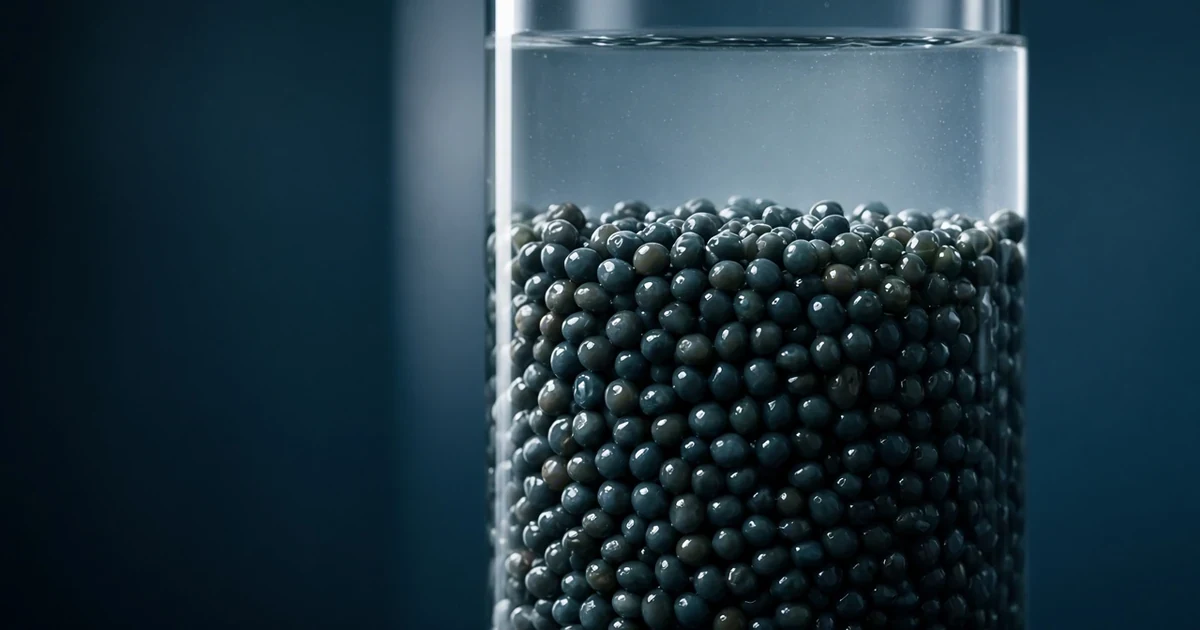
Aerobic granular sludge replaces loose flocs with dense, compact granules. The change sounds small. It reshapes the whole plant.
- Granules form when the process selects for dense biomass and washes out light flocs.
- Settling is fast, with a sludge volume index of 35–45 mL/g, so clarification needs less volume and less time.
- Layers inside each granule create oxygen-rich outer zones and oxygen-poor inner zones, so nitrification, denitrification and phosphorus uptake run in one tank.
- Retention time falls because the biology works harder per cubic metre, which frees tank volume for extra flow.
- Footprint shrinks because fewer and smaller tanks carry the same load.
The result is capacity that comes from biology, not concrete.
Foshan cut hydraulic retention time 57% and land use 70%
The Foshan plant treats 20,000 m³/day of mixed wastewater: 70% industrial and 30% domestic. MediSun describes it as an aerobic granular sludge pioneer project. The owner needed in-situ expansion without new land.
- Hydraulic retention time: cut 57%.
- Land footprint: cut 70%, to 0.043 m² per m³/day of capacity.
- Total phosphorus: halved without additional chemical agents.
- Sludge settleability: sludge volume index of 35–45 mL/g for aerobic granular sludge.
The phosphorus result matters for operating cost. Chemical phosphorus removal adds a recurring dosing bill and extra sludge. At Foshan the granules did that work biologically.
Mixed industrial and domestic feed is a demanding test. Industrial streams vary in strength and composition through the day.
In-situ expansion suits crowded urban and industrial sites
Foshan is an in-situ upgrade. The same logic applies wherever a plant must grow inside a fixed boundary.
Urban utilities face population growth around plants that were once on the city edge. Expanding in place avoids land acquisition and new trunk sewers.
Industrial parks add tenants, and each tenant adds load. Mixed industrial and domestic feeds, like Foshan’s, are common in these parks across Southeast Asia and the Gulf.
New-build complexes can be designed compact from day one. RECLAR Pro uses aerobic granular sludge with magnetic flocculation and UV. It delivers 30,000 m³/day in about 0.20 m² per m³/day of capacity, with a 60–90 day turnaround.
Other in-situ tools sit alongside granular sludge. The Sludge Smart-Particle System adds 30–50% in-situ capacity without halting production, deployed in 2–3 months. At Zengcheng, a rainy-season upgrade raised capacity from 150,000 to 200,000 m³/day without new land.
Aerobic granular sludge is commercial and running today
Aerobic granular sludge is in commercial operation at Foshan. It is also the core biological process in RECLAR Pro.
MediSun’s biochemical control system supports these plants. It is proven in over 30 projects at scales exceeding 1 million tons of wastewater treatment, with more than 10% electricity savings and 30% less external dosing.
For owners, the lesson is practical. A plant short on land is not necessarily short on capacity. It may be short on the right biology.
Compact treatment also changes where plants can go. A plant that needs 70% less land fits on sites that a conventional design would rule out. That makes it easier to place treatment close to where wastewater is produced.
For the full containerised range, read Containerised sewage treatment plant: RECLAR ships in months.
The next era of water will be built smaller, closer and everywhere.
Next step: Discuss an in-situ expansion with the RECLAR team via the RECLAR product page.