Solar powered desalination: The roadmap to zero-carbon water
Desalination needs power that remote sites lack; MediSun’s roadmap pairs VASAR with solar and storage, starting from a measured energy baseline.
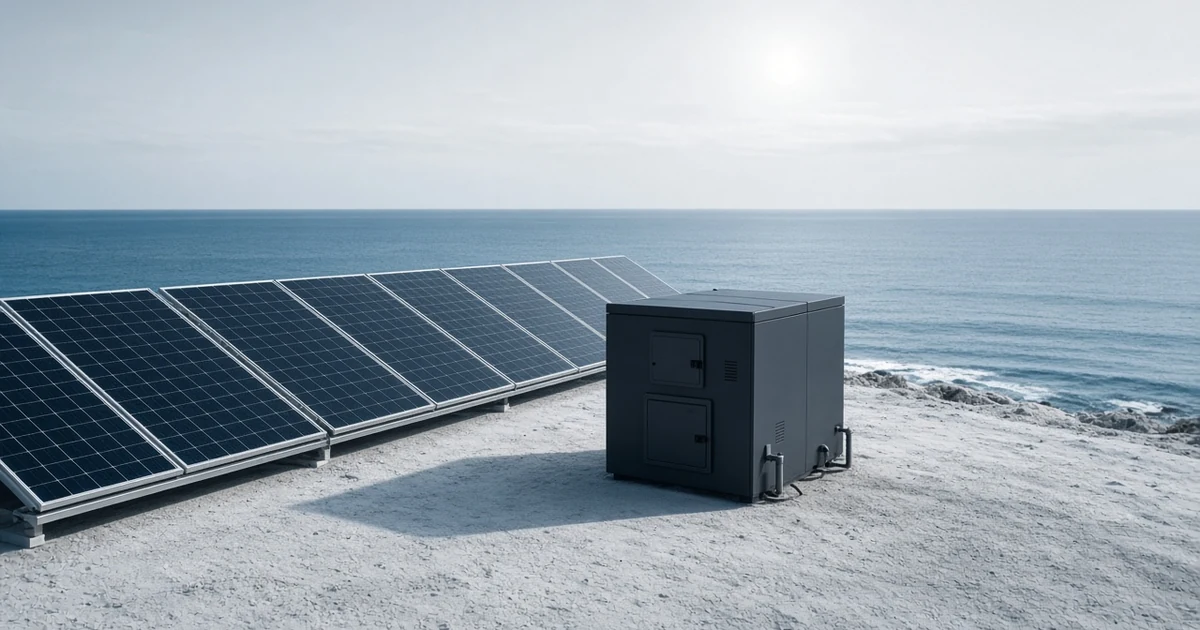
Desalination runs on energy, and energy is the constraint
The world’s desalination plants produce 95.37 million m³/day of water. The Middle East and North Africa region produces 48% of it (Jones et al., 2019).
Large plants draw that energy from national grids. Remote sites cannot. An island, a desert settlement or a research station often runs on a diesel generator or a weak line. Fuel for that generator arrives by road or by sea.
The sun is the obvious alternative in these regions. Solar powered desalination links a free, local energy source to a local water source. The engineering question is how to match a variable supply to a steady process.
MediSun’s solar and storage plan is a roadmap configuration
The configuration in this post is not yet a shipped product. It is a defined roadmap configuration for VASAR.
VASAR and VASAR Pro ship today for a standard power connection. The solar and energy storage system (ESS) pairing is the next step.
The VASAR film presents the end state as zero-carbon water (MediSun VASAR film). This post sets out how that end state is built and what is already measured.
How solar powered desalination works in four steps
- Collect energy through solar modules rated at 470 W each.
- Store surplus energy in an ESS that accepts 4,000 W of solar input and holds 2.6 kWh.
- Desalinate seawater or brackish water through VASAR’s ultrafiltration and reverse osmosis train, with energy recovery returning reject-stream pressure to the feed.
- Deliver water after KDF, UV disinfection and mineralisation, with production timed to the solar and storage profile.
The order matters. Energy recovery lowers the demand, so the array and battery can stay small. Storage then smooths cloud cover and short gaps in sunlight.
Energy recovery is the reason the load stays small. Reject leaves the RO membrane at high pressure. The recovery device returns that pressure to the feed instead of wasting it.
The design starts from a measured 3.5 kWh/m³
A solar system is sized from load data. Desalination energy consumption is the first input, and the roadmap uses figures already in hand.
- Measured energy: 3.5 kWh/m³ on seawater, measured on site across the Dapeng pilot (MediSun VASAR Catalogue V4; MediSun VASAR film).
- Connected load: 0.6 kW for VASAR at 1,200 L/day; 2.8 kW for VASAR Pro at 9,600 L/day.
- Solar module: 470 W per module.
- Energy storage: 4,000 W solar input; 2.6 kWh stored.
- Electricity claim: 40% less electricity than traditional equipment, as stated in the brochure.
The measured figure came from seawater at 33,600 mg/L TDS. Brackish feed carries less salt and needs less pressure.
Module count, autonomy hours and daily output under solar operation depend on site irradiance and duty cycle.
Islands and deserts hold both the sun and the water
Two deployment fronts suit this roadmap.
Coastal communities come first. Fishing villages, islands and atolls sit on seawater. Solar desalination for islands aims to remove the fuel line as well as the water truck.
Deserts come second. They hold brackish groundwater and a high solar resource. Lower feed salinity and strong sunlight make the energy balance easier.
The roadmap also has an industrial partner. On 3 Aug 2026, at DRT SHOW Chengdu, MediSun and JA signed an ecosystem MoU (press release). JA provides PV, battery storage and green power. MediSun provides compact VASAR desalination. The MoU targets zero-carbon water systems for islands and coastal environments.
Status: measured baseline, roadmap power
The deployment status is plain. VASAR and VASAR Pro are available on a standard power connection. One seawater pilot has produced measured energy data. Solar plus storage is a roadmap configuration under an ecosystem MoU, not a shipped product.
The hardware already suits remote sites. VASAR weighs 40 kg, a two-person lift. VASAR Pro rolls on casters and fits a standard doorway. Both can stand beside a future array.
Each step removes one dependency. The pipe goes first. The fuel truck goes next.
A water system that draws on local sun and local water answers to no distant supply line.
The next era of water will be built everywhere, under the same sun.
Next step: See where solar and desalination meet the hardest supply problem in Island water supply: desalination where the mainland grid ends.