WEGen: Salinity gradient power for SWRO desalination plants
SWRO plants pay in energy for every gram of salt and discharge brine; WEGen turns the salinity gap into electricity and levels the reject.
Desalination discharges 141.5 million m³ of brine a day
Desalination plants worldwide produce 95.37 million m³/day of fresh water and 141.5 million m³/day of brine (Jones et al., 2019). Brine disposal is costly and carries negative environmental impacts.
A seawater reverse osmosis (SWRO) plant pays twice for salt. Its high-pressure pumps work against the salinity of the feed. The pressure required rises with feed salinity, so salt removed upstream lowers the load on the pumps. Its reject line then carries concentrated brine back out.
Both costs come from the same thing: the difference in salinity between streams. Salinity gradient power uses that difference as a source of electricity.
Salinity gradient power turns a salt difference into a voltage
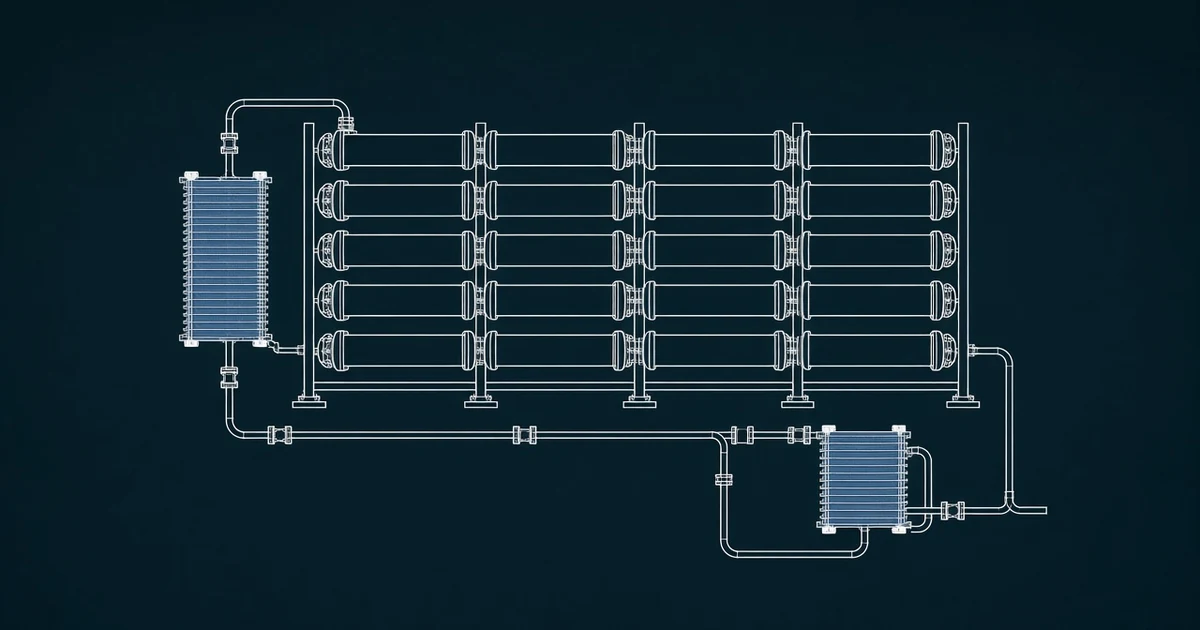
WEGen is the energy core of the MediSun platform. It is a retrofit for SWRO plants built on reverse electrodialysis (RED), a form of salinity gradient power.
- Pair: two streams of different salinity flow through a RED stack, separated by ion-exchange membranes.
- Drive: the salinity difference pushes ions through the membranes and builds a voltage across the stack.
- Dilute: at the intake, the stack lowers feed salinity by up to 30% before the water reaches the RO membranes.
- Level: on the reject line, brine passes through RED stages and leaves at seawater salinity.
- Retrofit: the stacks fit existing RO plants and stack together for higher volumes.
The MediSun master film puts it in one line: WEGen generates electricity from salinity itself (MediSun master film). The plant gains power and sheds load in the same step.
Each stack is a module. Plant owners add stacks as flow rises, in the same way RO racks scale.
WEGen at the intake and the outfall, in five figures
These figures come from the MediSun WEGen brochure. The salinity values are worked examples from Southeast Asian water.
- Up to 2.9 kWh of renewable energy per stack. Each stack handles 500 m³, and stacks combine for high-volume plants.
- Up to 30% lower intake salinity: in the example, seawater at 35,000 ppm reaches the RO intake at 25,000 ppm.
- Up to 30% lower SWRO specific energy consumption, as a result of the lower feed salinity.
- Reject levelled from 50,000 ppm to 35,000 ppm: the brine leaves at seawater salinity before discharge.
- Retrofit-compatible with existing RO plants, so the base plant stays in service.
Specific energy consumption measures the energy an SWRO plant uses per m³ of product, in kWh/m³. A cut at the intake applies to every cubic metre the plant makes.
The two salinity examples work at opposite ends of the plant. The intake stack dilutes the feed. The reject stack brings the brine back down to the level of the sea.
Levelling the reject simplifies desalination brine discharge: no further brine handling is needed. The discharge leaves at the salinity of the sea it enters.
Existing SWRO plants in the Gulf and Southeast Asia
Saudi Arabia, the UAE, Kuwait and Qatar account for 55% of global brine production (Jones et al., 2019). The Middle East and North Africa region produces 48% of the world’s desalinated water. A retrofit there works on plants already in place.
WEGen fits plants that already run and cannot stop for a rebuild:
- Municipal SWRO plants that want lower specific energy without replacing pumps or membranes.
- Coastal industrial plants that run their own desalination and carry discharge permits.
- Southeast Asian SWRO plants, where the brochure’s salinity examples come from.
Plants that discharge into enclosed or shallow waters gain most from a reject at seawater salinity.
A retrofit adds to a plant that already has a site, a permit and an intake. The energy and brine gains arrive without a new build.
WEGen RED is running at pilot scale
WEGen is at pilot stage. Under Project Elixir in Abu Dhabi, a WEGen RED system treats 500 m³/day of desalination brine and generates blue energy (PR Newswire, 23 May 2025). The Project Elixir case study (Project Elixir: Brine mineral recovery for steel in Abu Dhabi) sets out the systems and roles.
The pilot treats brine, the reject side of the process. The intake configuration in the brochure applies the same stack to the feed side.
MediSun has written on the method before. Sustainable desalination covers the 30% energy reduction. Hidden power explains salinity gradient power.
A decentralised water network can draw part of its own power from the water it treats.
The salt that costs energy can also make it.
Next step: To assess a WEGen retrofit on an existing SWRO plant, contact info@medisun.energy.