Project Elixir: Brine mineral recovery for steel in Abu Dhabi
Gulf desalination leaves brine to dispose of; Project Elixir tests turning it into blue energy and a furnace mineral at a steel plant.
Four Gulf states produce 55% of the world’s brine
Saudi Arabia, the UAE, Kuwait and Qatar account for 55% of global brine production (Jones et al., 2019). The Middle East and North Africa region produces 48% of the world’s desalinated water.
Brine disposal is costly and carries negative environmental impacts (Jones et al., 2019).
The same region runs heavy industry with its own carbon footprint. Steelmakers use dololime in the electric arc furnace. Brine mineral recovery offers a way to supply part of that need from a waste stream.
Project Elixir runs two WEGen systems at one steel site
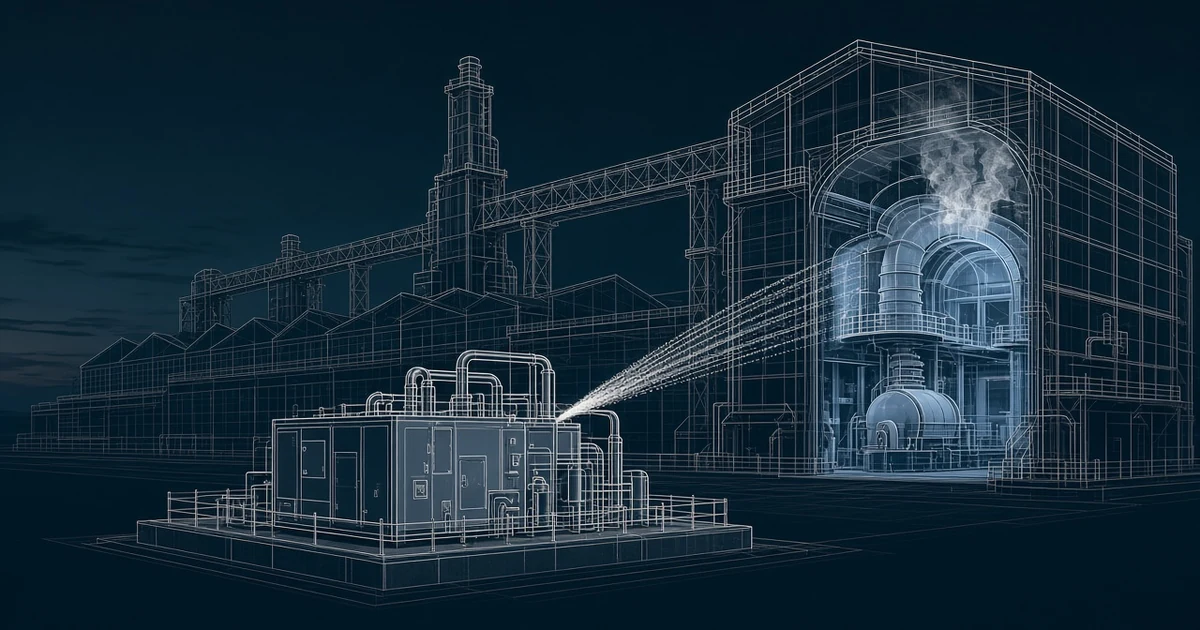
MediSun Energy and EMSTEEL (ADX: EMSTEEL) launched Project Elixir at EMSTEEL’s steel business unit in Abu Dhabi. The pilot turns desalination brine into renewable “blue energy” and magnesium carbonate (PR Newswire, 23 May 2025).
The pilot pairs the energy core with the minerals core.
- Generate: a WEGen RED system treats 500 m³/day of desalination brine and generates blue energy by reverse electrodialysis (PR Newswire).
- Precipitate: a WEGen Green pilot takes 30 m³/day of brine, and sodium hydroxide drops the magnesium out as magnesium hydroxide (PR Newswire; MediSun WEGen Green Brochure).
- Capture: CO₂ enters the slurry as nano- and microbubbles and forms hydromagnesite.
- Produce: the line dewaters and dries the solid into up to 300 kg/day of magnesium carbonate (PR Newswire).
- Substitute: EMSTEEL trials the MgCO₃ as a lower-carbon substitute for dololime in its electric arc furnace (PR Newswire).
Reverse electrodialysis is a form of salinity gradient power. The salinity difference between two streams drives ions through ion-exchange membranes and builds a voltage.
In Elixir, the energy core and the minerals core work on the same class of feed: desalination brine. One produces electricity from its salinity. The other recovers its magnesium and binds CO₂.
Brine mineral recovery at Elixir, in five figures
The two systems differ in scale. WEGen RED handles the larger brine flow; the WEGen Green pilot runs a smaller flow for mineral production.
The first three figures describe the pilot as announced. The last two are WEGen Green design figures from the product brochure, not pilot results.
- 500 m³/day of desalination brine treated by the WEGen RED system (PR Newswire, 23 May 2025).
- 30 m³/day of brine processed by the WEGen Green pilot (PR Newswire, 23 May 2025).
- Up to 300 kg/day of MgCO₃ from the WEGen Green pilot (PR Newswire, 23 May 2025).
- 95% magnesium recovery and 95% MgCO₃ purity as WEGen Green design figures.
- 3.1 kg of CO₂ offset per tonne of brine processed, as a WEGen Green design figure.
Three companies split the delivery
The release sets out a clear division of work (PR Newswire, 23 May 2025).
- MediSun leads engineering, installation and operation.
- EMSTEEL supports the pilot on site.
- Emirates Electrical & Instrumentation Company (EEIC) assists with local assembly and integration.
The release planned installation for mid-2025. Local assembly and integration sit with a UAE partner.
This split matches the stage of the project. A pilot needs the technology owner close to the equipment, so MediSun runs it directly.
The model places the technology owner in charge of operation. The host plant provides the site and the end use for the product.
The steel trial points to wider uses
Project Elixir tests one end use in one industry. For a steelmaker the test is practical: the furnace trial shows whether the substitute fits the process. The same pairing of brine and CO₂ applies wherever desalination and heavy industry share a coast.
WEGen Green produces four materials, each with its own uses:
- Magnesium carbonate for eco-friendly construction materials and industrial uses.
- Magnesium hydroxide for wastewater treatment and flame retardants.
- Magnesium oxide for refractories, agriculture and battery technologies.
- Hydromagnesite for carbon sequestration, ceramics and fire-resistant coatings.
The steel trial covers the furnace route. Other routes depend on local markets and on the brine each site produces. Each new end use needs its own product specification and its own buyer.
Pilot results come next
Project Elixir is a pilot. MediSun will share pilot results once the data has been reviewed.
MediSun first reported the launch in Project Elixir. This post sets out the systems, capacities and roles behind it.
A decentralised water network turns its by-products into inputs for the industry next door.
Brine can feed the furnace instead of the sea.
Next step: To discuss brine mineral recovery at a desalination or industrial site, contact info@medisun.energy.