VASAR: An off-grid desalination system for water beyond the pipe
Coasts and deserts often sit on salty water with no pipe; VASAR desalinates it on site at 1,200 to 9,600 litres per day.
Unsafe water kills one person roughly every 22 seconds
At least 1.4 million deaths in 2019 were attributable to unsafe drinking water, sanitation and hygiene (WHO, 2023). That is roughly one death every 22.5 seconds: 31.5 million seconds in a year divided by 1.4 million deaths.
Pipe networks do not reach every fishing village, island or desert settlement. Many of these places sit beside seawater or above brackish groundwater. Their remote water supply falls back on rainwater, trucked water or untreated sources.
An off-grid desalination system changes the order of operations. It treats the water already on site, so the water does not have to travel.
The off-grid desalination system runs five stages in one frame
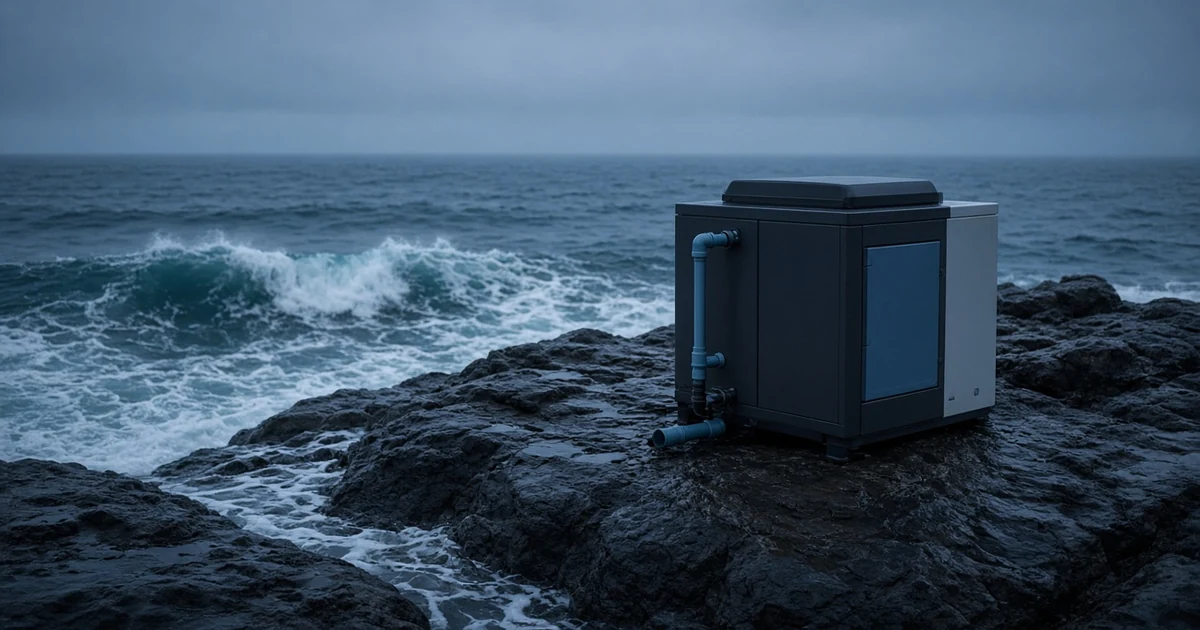
VASAR is MediSun’s compact desalination unit. It packs a full treatment train into one frame.
- Ultrafiltration removes solids and organics before the membrane, and backwash keeps the immersed modules clean.
- Reverse osmosis uses a high-pressure pump to drive feed water through the membrane and hold back the salt; on the coast this is seawater reverse osmosis.
- Energy recovery returns pressure from the reject stream to the feed, so the pump does less work.
- Disinfection passes the permeate through KDF media and UV light.
- Mineralisation restores taste before the water reaches the tap.
A visualisation window shows a live schematic of the process. It also diagnoses faults stage by stage, so a local operator can see which stage needs attention.
Two models span 1,200 to 9,600 litres a day
- VASAR: 50 L/h and 1,200 L/day; 0.6 kW connected load; 40 kg; 610 × 320 × 497 mm.
- VASAR Pro: 400 L/h and 9,600 L/day; 2.8 kW connected load; 255 kg; 680 × 600 × 1,600 mm, on casters, fits a standard doorway.
- People served: 60 people/day for VASAR and 480 people/day for VASAR Pro, at the WHO-based basic-access basis of 20 L/person/day (WHO emergencies Q&A; MediSun VASAR Catalogue V4).
- Measured energy: 3.5 kWh/m³, measured on site across the Dapeng pilot on seawater at 33,600 mg/L TDS (MediSun VASAR film; MediSun VASAR Catalogue V4).
- Electricity claim: 40% less electricity than traditional equipment, as stated in the brochure.
VASAR is compact, but it is not a one-person device. At 40 kg it is a two-person lift. VASAR Pro rolls on casters through a standard doorway.
Coastal villages and desert settlements need water made on site
VASAR has two deployment fronts.
The first is the coast. Fishing villages, islands and atolls sit on seawater but often lack a mainland supply. A VASAR unit draws that seawater and produces drinking water beside the point of use.
The second is the desert. Desert sites often hold brackish groundwater and a high solar resource. The same treatment train handles the lower salinity of brackish feed.
The segments are specific. Research stations, remote clinics, island resorts, border posts and disaster-relief programmes all share one constraint: no pipe, and a long road for every truck.
The first field reference is a marine research base. At the Dapeng Coral Conservation Station in Shenzhen, VASAR replaced a dependence on rainwater and trucked water. It ran on a standard single-phase line. The full results sit in the Dapeng case study.
Solar and storage are the roadmap, not the shipping product
VASAR and VASAR Pro run today on a standard power connection. At Dapeng, VASAR ran on a single-phase line. In this post, “off-grid” means off the water grid: the unit needs no pipe network.
Grid-free power is the next step, and it is not yet a shipped product. The roadmap configuration pairs VASAR with solar modules of 470 W each. An energy storage system (ESS) takes 4,000 W of solar input and stores 2.6 kWh. The VASAR film presents this as zero-carbon water. That outcome depends on the solar and storage configuration reaching the market.
Specifiers should plan on these terms:
- Today, VASAR and VASAR Pro need a power connection or a local generator.
- Field data exists for one seawater pilot, at 3.5 kWh/m³.
- Solar plus storage is a roadmap configuration.
The sequence is deliberate. Prove the water first, then remove the cable. The low connected loads of 0.6 kW and 2.8 kW keep the future solar array small.
Water does not have to wait for a pipeline. It can be made where people live.
The next era of water will be built everywhere, not bigger.
Next step: See how VASAR performed on seawater at a coral research base in Dapeng: a seawater desalination case study.