Modular Water Treatment Plant: Factory-built, Shipped in Months
Site-built water plants carry schedule and civil-works risk; factory-built modules are tested before shipping and commissioned in weeks.
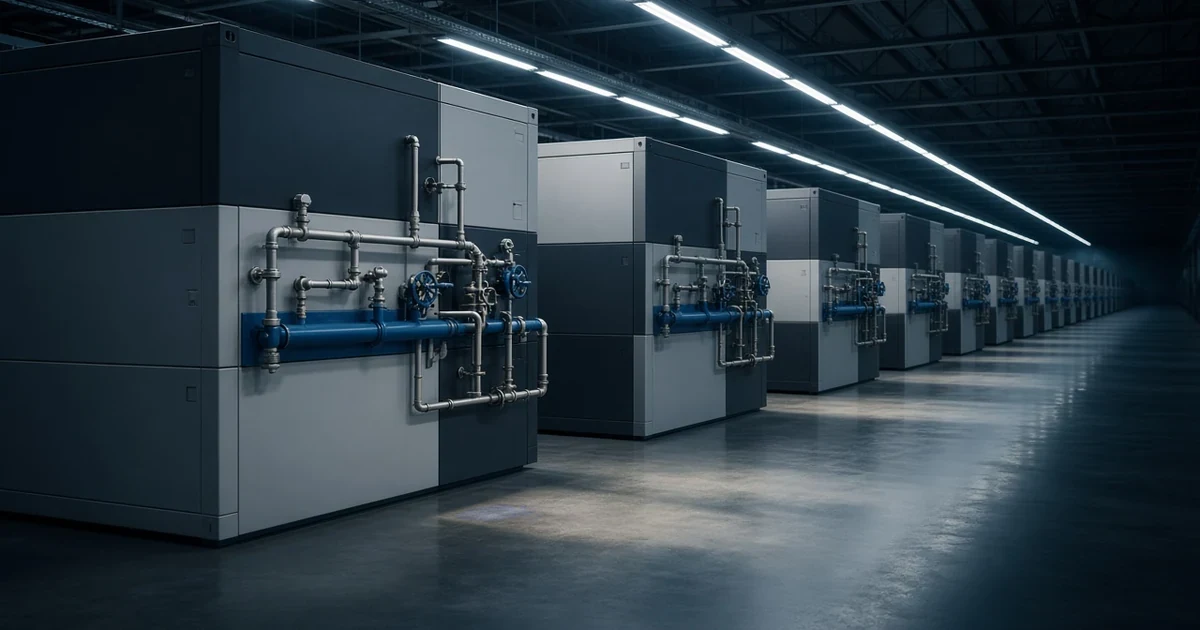
Construction risk sits on the site, and the site is where projects slip
The world runs 15,906 operational desalination plants (Jones et al. 2019). Each one is a fixed asset at a fixed site. A conventional treatment plant is built where it will run, and concrete tanks are poured on site. Pumps and controls are wired in the open. Weather, ground and labour supply set the schedule.
A distributed wastewater network in Serbia shows the alternative. The 8,500 PE network was delivered and commissioned in 180 days. Construction time fell 50% and civil works cost fell 80%.
A modular water treatment plant takes most of that work off site. The plant is built and tested in a factory, then shipped. The site receives a finished system.
Plants built on an assembly line, not a construction site
The MediSun master film states the principle directly. Plants are built on an assembly line, not a construction site (MediSun master film, “The World of MediSun Planet”). They can be assembled, disassembled and reassembled elsewhere.
That changes who carries risk. In a factory, welding, wiring and testing follow a fixed sequence. Defects surface at factory acceptance testing, before shipping. The site team then connects pipes and commissions.
RECLAR, MediSun’s containerised wastewater line, is the worked example. Each system treats 500–2,000 m³/day in 40 ft High Cube ISO containers measuring 12.19 m × 2.44 m × 2.90 m. Units arrive pre-wired, pre-tested and plug-and-play.
How a modular water treatment plant goes from factory to service
- Build the treatment train inside standard containers on a factory line: pretreatment, biological treatment, membrane bioreactor and disinfection.
- Test every unit at factory acceptance testing, so wiring and process faults are found before shipping.
- Ship the containers as standard freight in 40 ft High Cube ISO format.
- Connect inlet, outlet and power on a prepared pad, so pipe connection and commissioning take weeks.
- Relocate the plant when demand moves, because modules can be disassembled and reassembled elsewhere.
The membrane bioreactor stage drives the small footprint. Its ultrafiltration membranes, at 0.01–0.1 µm, separate solids, bacteria and viruses without large settling tanks. The process produces less sludge and needs less land.
The numbers from RECLAR deliveries
- 3–6 months for manufacturing, shipping and installing a RECLAR system of 500–2,000 m³/day; pipe connection and commissioning take weeks.
- 67% footprint reduction compared with traditional design.
- 45 days to manufacture, deliver and assemble a 1,200 m³/day plant at Duyun.
- 15–35 days of on-site assembly for RECLAR Plus, a 5,000 m³/day hexagonal modular plant in Q355NH weathering steel with >20 years life.
- 60–90 days turnaround for RECLAR Pro, a 30,000 m³/day complex using ~0.20 m² per m³/day of land.
Where factory build pays first
Factory build pays most where site work is expensive or slow. Remote industrial estates fit that description. So do island and desert sites, where skilled labour and materials must travel.
Land-constrained cities fit too. A 67% footprint reduction lets a plant sit on a parcel too small for a conventional design. RECLAR Pro needs about 0.20 m² of land per m³/day of capacity.
Scale is not a barrier. The same factory approach runs from modular units of 30–200 m³/day, of which over 10,000 have been delivered, to the 30,000 m³/day RECLAR Pro complex.
The approach extends beyond wastewater. HYDAR packs an 8-stage drinking-water treatment train and a bottling line into one 40 ft container on a 10 m² footprint. It moves by truck, ship, rail and crane.
The WaterHouse drinking-water line, made up of WaterCube and i-WaterHub, follows the same factory sequence. Its modules are commissioned before shipment, delivered in 3–6 months and commissioned on site in 1–2 weeks.
Factory-built plants are in commercial delivery now
RECLAR, RECLAR Plus and RECLAR Pro are commercial product lines with delivered references. The modular wastewater units are in volume service. HYDAR is built and operating.
The change for project owners is in sequencing. Civil works shrink to a pad and connections. Procurement becomes a delivery date. Schedule risk moves from the field to a factory floor, where it can be controlled.
Water infrastructure can now be manufactured, shipped and moved.
Next step: Review the full containerised range, from 500 m³/day units to the 30,000 m³/day complex, on the RECLAR product page.