Inland brine disposal: Ponds, trucks and thermal ZLD
Inland desalination plants have no sea to take their brine; recovering the water and salt replaces disposal as a permanent cost.
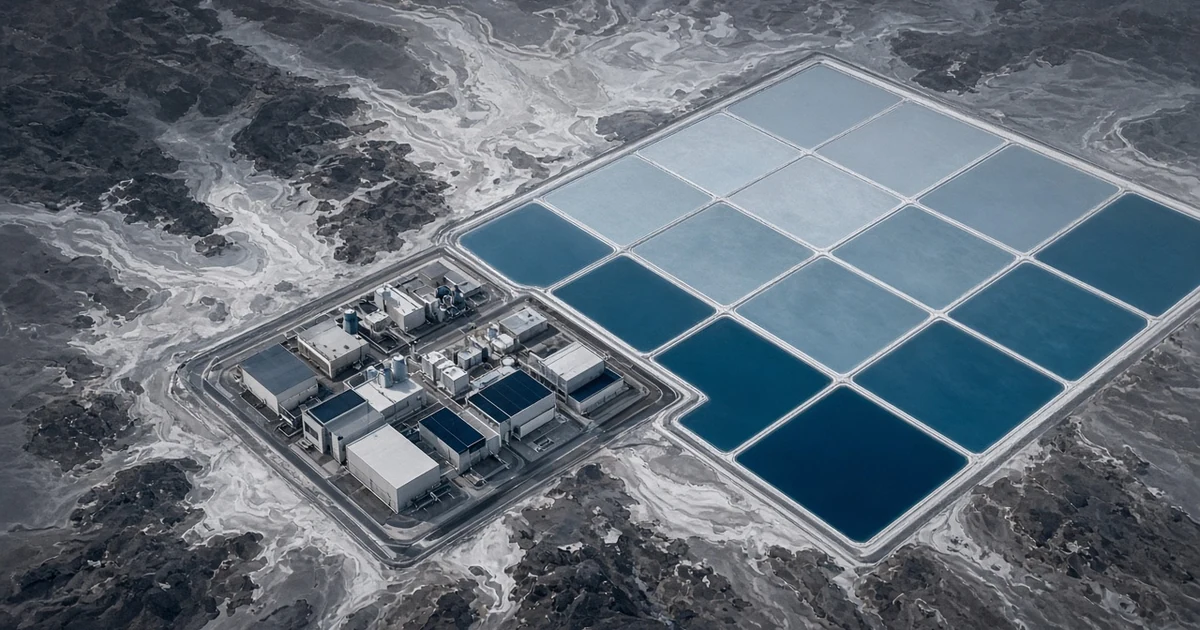
Desalination makes 141.5 million m³ of brine every day
Desalination plants worldwide produce 141.5 million m³/day of brine (Jones et al., 2019). That is about 1.5× the 95.37 million m³/day of fresh water they make.
Coastal plants send most of that brine back to the sea. Inland plants often have no marine outfall. Take a brackish-water reverse osmosis (BWRO) plant in a desert or a river basin. There, inland brine disposal sets the long-run cost of every cubic metre it produces.
The same study concludes that brine disposal is costly and carries negative environmental impacts (Jones et al., 2019). Inland, the operator carries both.
Inland brine disposal has three routes, and each one recurs
A BWRO plant splits brackish feed into two streams. Fresh water passes the membrane. The salt stays behind in the BWRO reject, a hyper-concentrated stream (MediSun BrineHouse film).
That reject then follows one of three routes. None of them ends.
- Ponds are brine evaporation ponds that hold the reject in the open, take land, and can leak into the aquifer the plant draws from.
- Trucks carry the reject to off-site disposal, so the plant pays for haulage every day it runs.
- Thermal zero liquid discharge (ZLD) boils off the remaining water, which needs high energy and high capital.
Thermal ZLD is expensive for a physical reason. Conventional RO stops when osmotic pressure wins, so heat must finish the job (MediSun membrane portfolio film). Every route then repeats for the life of the plant.
Ponds trade money for land. Trucks trade land for a running bill. Thermal ZLD trades both for energy. The salt itself is never used.
Brine volumes concentrate in a handful of regions
The global numbers frame the scale. They come from a census of operational plants, so the figures describe daily output, not design capacity.
- 141.5 million m³/day of brine produced worldwide, about 50% higher than earlier estimates (Jones et al., 2019).
- 95.37 million m³/day of desalinated water produced, so brine runs at about 1.5× the fresh water output (Jones et al., 2019).
- 15,906 operational desalination plants worldwide (Jones et al., 2019).
- 48% of desalinated water is produced in the Middle East and North Africa region (Jones et al., 2019).
- 55% of global brine production comes from Saudi Arabia, the UAE, Kuwait and Qatar (Jones et al., 2019).
These figures cover seawater and brackish plants together. The global study does not split out the inland share.
Brackish groundwater plants carry the heaviest disposal burden
The burden is highest where a plant is far from the coast and close to its users.
Desert municipal supply. Brackish groundwater feeds towns and settlements across the Gulf interior. Each plant needs a disposal route that lasts as long as the aquifer.
Industrial water users. Mines, chemical plants and food processors run BWRO for process water. Their disposal route must not cap production.
Industrial parks and river basins. Parks far from the coast discharge to rivers, not the sea. Operators there face the same three routes.
Decentralised plants. Small plants serve the communities that pipes do not reach. A small plant cannot carry the cost of a thermal ZLD unit or a fleet of trucks.
Recovery tools are commercial; the integrated plant is next
The alternative to disposal is recovery. MediSun builds the parts of that chain today.
High-salinity RO (HSRO) takes brine to 150 g/L and does the work of disc-tube RO (DTRO) without its maintenance burden (MediSun membrane portfolio film). Electrodialysis concentration stacks concentrate brine to 160–200 g/L.
Bipolar membrane electrodialysis (BPED) then splits the waste salt into acid and alkali. Three-compartment stacks produce up to 73 g/L HCl and up to 80 g/L NaOH.
At a molybdenum processor, MediSun electro-membrane concentration with RO reached a concentrate of at least 140 g/L, product water at or below 0.1 g/L, and water recovery of at least 80%.
The components are commercial. BrineHouse joins them into one plant that locks onto an existing BWRO line. It is moving from engineering design to a full-process demonstration line.
Inland water will scale only as fast as its salt finds a use.
Next step: See how BrineHouse intercepts BWRO reject at the source in BrineHouse: BWRO brine treatment that recovers the water.