HYDAR: A mobile water bottling plant for the point of need
Disaster zones and remote sites depend on trucked water; HYDAR treats local water and bottles it on site from one 40 ft container.
Unsafe water causes one death every 22 seconds
At least 1.4 million people died in 2019 from unsafe drinking water, sanitation and hygiene (WHO, 2023). That is roughly one death every 22.5 seconds, on a basis of 31.5 million seconds a year.
The risk peaks when infrastructure fails. Floods contaminate wells and rivers. Pumping stations lose power, and pipes break.
Relief agencies then truck water in, every day, for as long as the crisis lasts. A mobile water bottling plant removes that convoy. It treats local water and seals it into bottles on site.
HYDAR runs a mobile water bottling plant inside one container
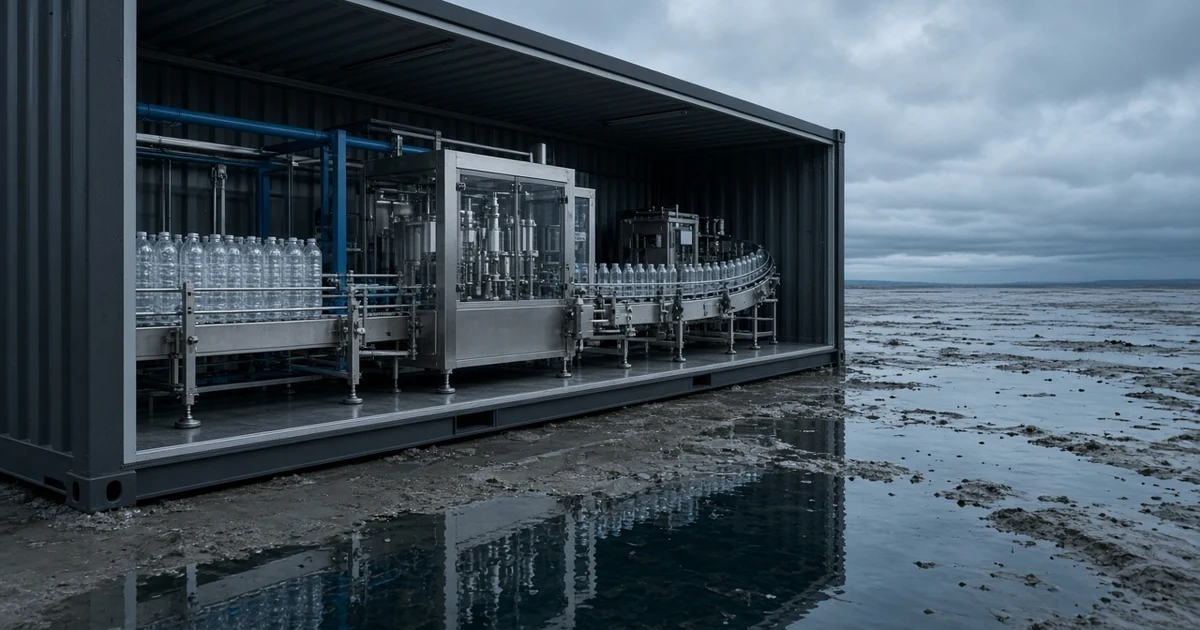
HYDAR is a decentralised water treatment and bottling system built into a heavy-duty 40 ft shipping container. It moves by truck, ship, rail and crane. One delivery arrives, and then water is made on site.
- Intake. HYDAR draws flood, river or well water through quartz sand, activated carbon and a precision filter.
- Purification. Reverse osmosis removes dissolved contaminants, and a mineralisation filter conditions the water for drinking.
- Disinfection. UV (2 × 55 W) and ozone (5 g) treat the water before a sterile tank, completing an 8-stage train rated at 2 m³/hour.
- Bottling. A blow-moulding unit makes 18.9 L (5-gallon) bottles on site, and a 4-station wash cleans each one after brushing and cap removal.
- Sealing. A 2-head filler works at stable pressure, and the line then caps, seals, date-codes and light-inspects every bottle.
The treatment train and the bottling line share one container and one power connection. Treated water passes from the sterile tank to the filler and into a sealed bottle. No separate transfer step sits between treatment and the person who drinks it.
One container bottles about 30,000 litres a day
- Bottle output: 1,600 bottles/day of 18.9 L, from blow-moulding at 80 bottles/hour; the filling line is rated at 100 bottles/hour.
- Daily volume: 1,600 × 18.9 L ≈ 30,240 L/day, or about 30,000 L/day of bottled drinking water.
- People served, drinking basis: about 10,000 people/day at 3 L/person/day (MediSun HYDAR film).
- People served, basic-needs basis: about 1,500 people/day at 20 L/person/day (MediSun master film).
- Site load: 10 m² footprint; 70 kW, three-phase 380 V.
Bottle production, not treatment, sets the daily output. The treatment train is rated at 2 m³/hour, while the blow-moulder sets the 1,600 bottles/day figure.
The two people-served figures answer different questions. The 3 L basis sits at the top of the WHO survival band of 2.5–3 L/person/day for drinking and food (WHO Technical Note 9). The 20 L basis matches the WHO figure for basic hygiene and food hygiene (WHO emergencies Q&A).
HYDAR serves floods, remote sites and standing programmes
HYDAR treats flood, river or well water. It fits wherever a source exists but a treatment plant does not.
Disaster response is the first segment. Floods leave water everywhere and none of it safe to drink. HYDAR sits beside that water and converts it into sealed bottles.
Remote industrial and construction sites are the second. Mines, camps and work fronts often sit beyond the pipe network. A bottling plant on site replaces the daily supply run.
Government water programmes are the third. A containerised water treatment unit can be stored, lifted by crane and redeployed when the next event arrives.
Two variants change the bottle size. AquaPod fills 12 L and 15 L bottles at up to 200 bottles/hour. Sail fills 500 ml bottles at 1,000 bottles/hour.
“A pipe needs a grid. A bottle needs a hand.” (MediSun HYDAR film). In a pipe, water is a utility. Sealed in a bottle, it is safe, stackable and movable.
HYDAR is built and operating today
HYDAR is built and operating. It is a working system, not a roadmap. Agencies can plan it into flood and drought response now.
The model scales by count, not by size. Each container is an independent node. Ten containers are ten sources of emergency drinking water with no shared point of failure.
Planners can size a deployment from two inputs: the population and the litres-per-person basis.
Water infrastructure is moving from the distant reservoir to the point of need.
When the grid falls, the water keeps flowing.
Next step: See HYDAR specifications, variants and deployment options on the HYDAR product page.