Emergency drinking water supply: The resupply arithmetic
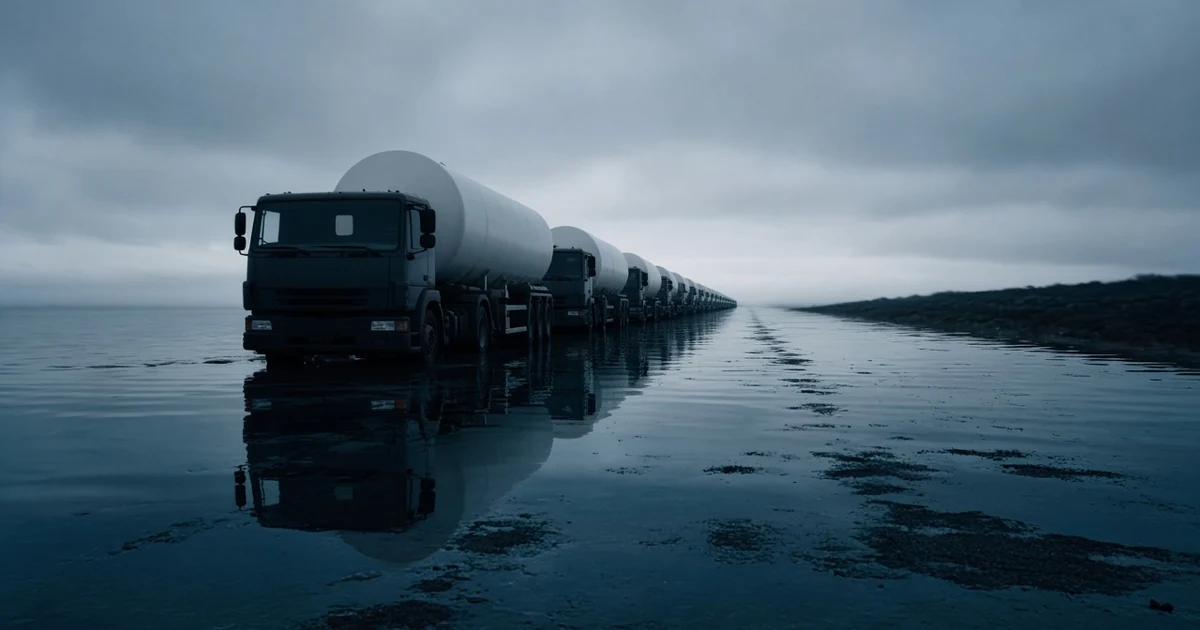
Trucked disaster water becomes a daily freight burden; producing and bottling water on site replaces the convoy with one delivery.
Survival needs 2.5–3 litres per person every day
The WHO sets survival water for drinking and food at 2.5–3 litres/person/day (WHO Technical Note 9). The same note puts the total survival minimum at 7.5–15 L/person/day once hygiene and cooking are added.
These numbers look small per person. They become large at the scale of a displaced town.
Every emergency drinking water supply plan begins with this arithmetic. Most plans then answer it with trucks.
Emergency drinking water supply is a freight problem first
The argument runs in four steps. Each step follows from the one before.
- Demand. Ten thousand people at 3 L/person/day need 30 tonnes of water every day (MediSun HYDAR film, illustrative).
- Recurrence. That demand returns every morning for as long as the crisis lasts, so the supply becomes convoy after convoy.
- Fragility. Every convoy depends on open roads, fuel and drivers, and floods often damage all three at once.
- Substitution. A system that treats local water and seals it into bottles converts a daily freight task into one delivery.
The fourth step is the thesis. Water is already present in most flood zones. It is unsafe, not absent.
Treatment therefore replaces transport. The heavy item, water, no longer travels. Only the plant travels, and it travels once.
The numbers behind the convoy
- Survival basis: 2.5–3 L/person/day for drinking and food (WHO Technical Note 9).
- Emergency minimum: 15 L/person/day, supplied as soon as possible; about 20 L/person/day for basic hygiene and food hygiene (WHO emergencies Q&A).
- Daily freight, illustrative: 10,000 people × 3 L = 30 tonnes of water per day (MediSun HYDAR film).
- On-site output: HYDAR fills 1,600 bottles/day of 18.9 L, about 30,000 L/day.
- Cost of failure: at least 1.4 million deaths in 2019 attributable to unsafe drinking water, sanitation and hygiene (WHO, 2023).
The HYDAR output carries two people-served figures. At 3 L/person/day it covers drinking water for about 10,000 people/day (MediSun HYDAR film). At 20 L/person/day it covers basic needs for about 1,500 people/day (MediSun master film).
Bottling matters as much as treatment
A treatment unit alone does not solve distribution. Treated water still has to reach people who have no working tap.
“A pipe needs a grid. A bottle needs a hand.” (MediSun HYDAR film). In a pipe, water is a utility. Sealed in a bottle, it is safe, stackable and movable.
Bottles move through the channels that still work after a disaster. People carry them. Boats ferry them. Relief points stack them.
Sealed bottles also protect quality after treatment. The water stays closed from the filler to the person who opens it. Open tanks and shared containers do not offer that protection.
HYDAR combines both functions in one 40 ft container. An 8-stage train treats flood, river or well water at 2 m³/hour. The line then blow-moulds, washes, fills, caps, seals and date-codes 18.9 L bottles.
The container moves by truck, ship, rail and crane. It arrives once. From then on, the water is made where the people are.
The model fits flood plains, camps and cut-off towns
The case is strongest where a water source exists and the supply route is weak.
Flood response is the clearest example. Floodwater surrounds the affected population but cannot be drunk untreated.
Displacement camps are a second example. Their populations persist for months, and daily trucking costs accumulate for the whole period.
Towns cut off by landslides or damaged bridges are a third. A container lifted in by crane can supply them while roads are rebuilt.
Each deployed unit is an independent node. Several units create several sources, with no single point of failure.
The model has a limit. HYDAR needs a local source of flood, river or well water. Where drought leaves no usable source, trucking remains necessary.
On-site bottling is available now
HYDAR is built and operating. Agencies can include on-site bottling in flood and drought plans today rather than wait for a future product.
The arithmetic does not change from one crisis to the next. Thirty tonnes a day for ten thousand people is a fixed burden (MediSun HYDAR film, illustrative). The choice is whether to carry it every day or produce it in place.
Planners can test the case with their own population figure. Multiply people by litres per person per day. The result is the daily load a convoy must carry.
Emergency water belongs at the point of need, not at the end of a supply line.
Next step: Review HYDAR specifications and deployment options on the HYDAR product page.