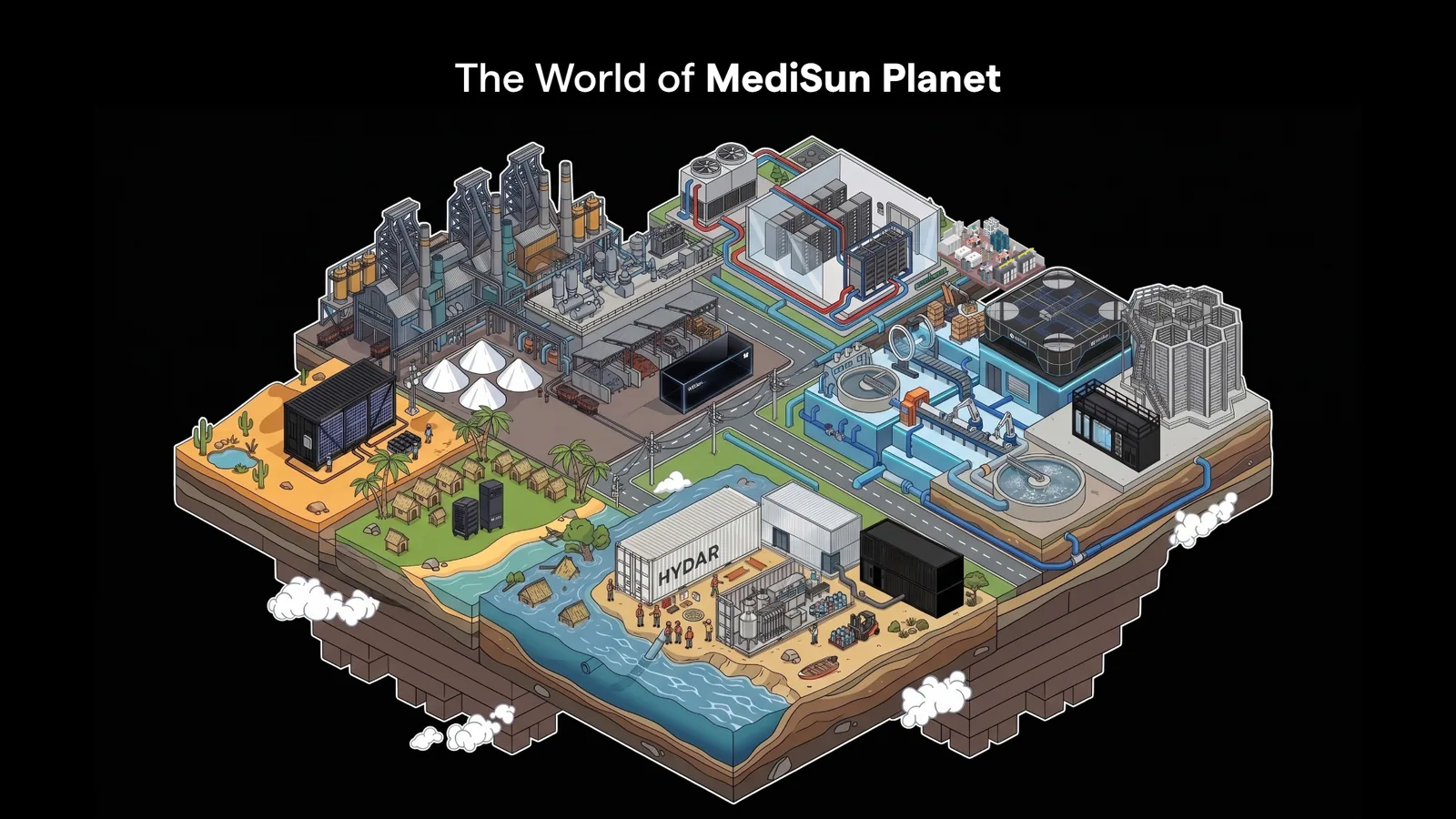
The World of MediSun Planet: Water made where people are
One plant and one pipe leave whole nations exposed. A point-of-service grid of factory-built nodes makes water where people use it.
Up to half the water a network treats never reaches a tap
Water security is the defining priority of our time. Yet most of the world still depends on one design: one large plant, feeding one long pipe.
That pipe is the most fragile thing we have ever depended on. The World Bank estimates that developing-country utilities lose 40–50% of the water they produce before it reaches a paying customer (World Bank, 2006). The utilities in its database report about 35%; the authors expect the true figure is higher. One plant is also one point of failure. When it stops, everything downstream stops with it.
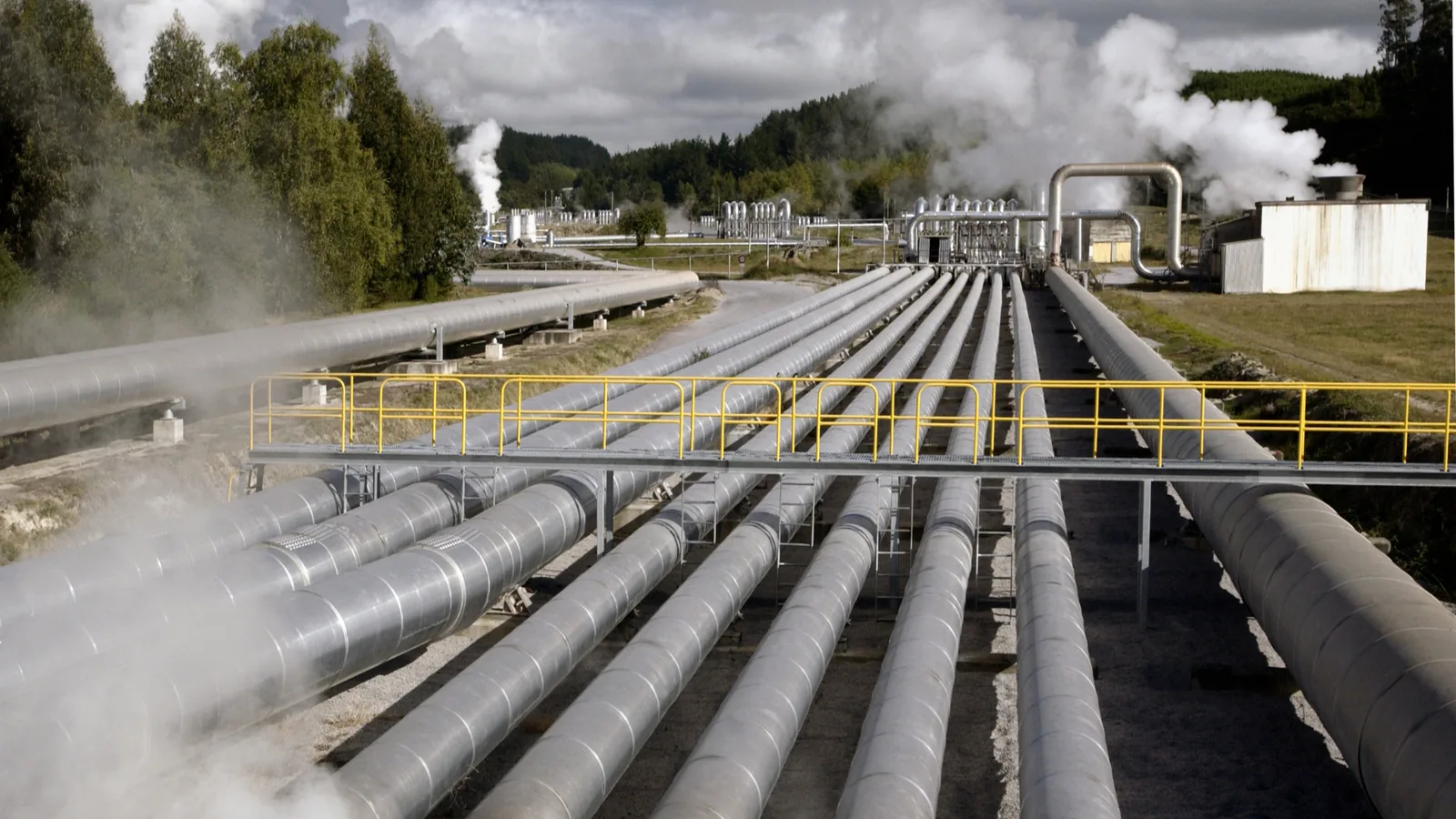
There are only two ways to move water
The centralised grid has one source, and everything downstream is at risk.
The point-of-service grid places production where the water is used. It runs on hundreds of nodes, each one independent. When one node stops, the rest keep producing.
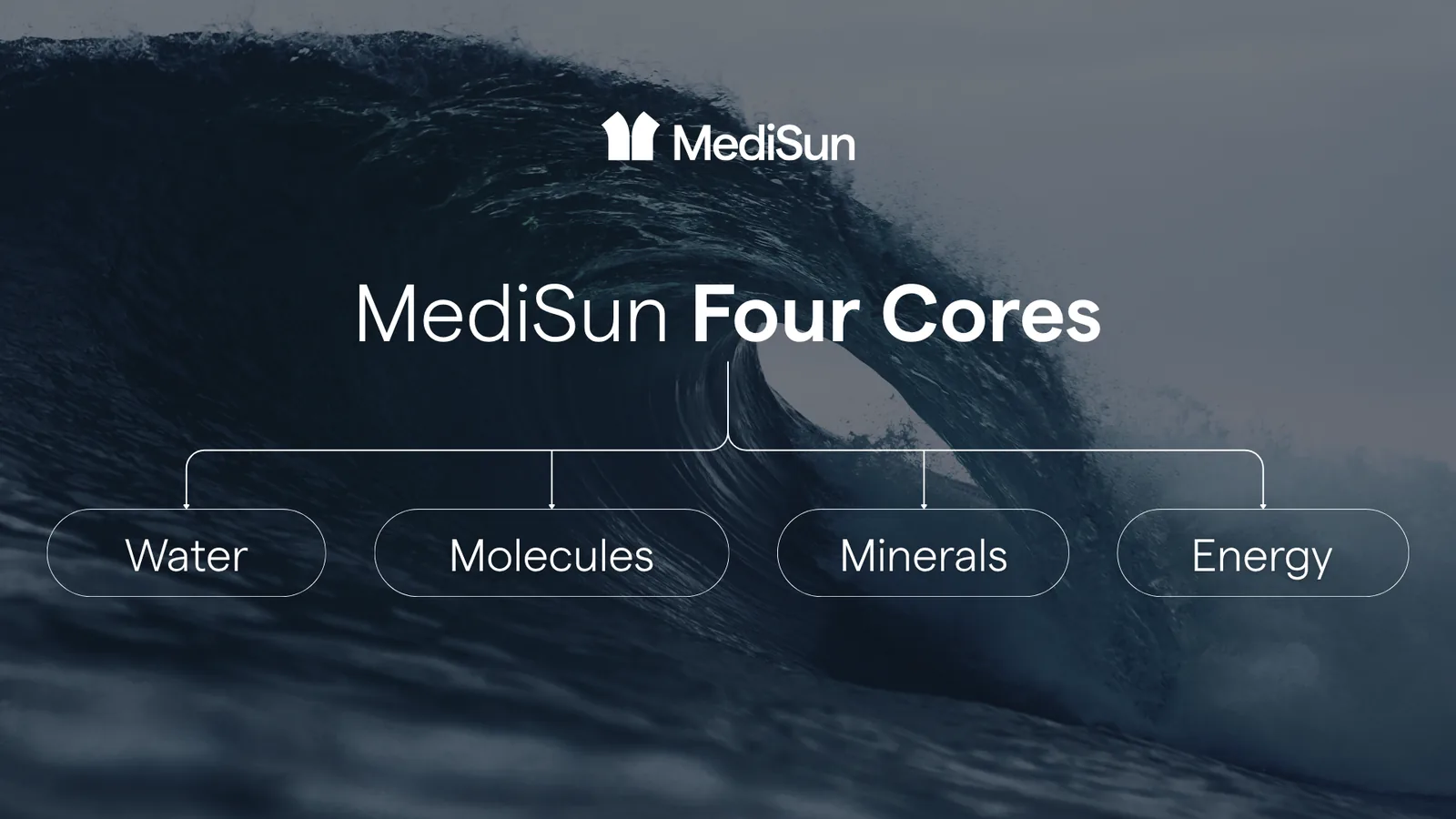
Decentralised water infrastructure is that second grid, and MediSun builds it. Every plant is factory-built, deployed in months and built on four cores. Look inside a single drop of seawater: water, molecules, minerals and energy are already there (MediSun Master Brand Film).
How decentralised water infrastructure runs on four cores
- Water. WaterCube and i-WaterHub treat brackish water or seawater, and RECLAR turns a city's wastewater back into water it can use again.
- Molecules. BPED takes the salt in brine apart into hydrochloric acid and sodium hydroxide, the chemistry a plant runs on.
- Minerals. WEGen Green combines brine with captured CO₂ and turns it into magnesium carbonate, locking the carbon away as it works.
- Energy. WEGen generates electricity from salinity itself, and Solra systems unfold their own solar in hours, because a node that needs a grid is not independent.
Two more machines take the grid further. VASAR shrinks the node small enough for a boat and powers it with the sun. When disaster takes the pipes out entirely, HYDAR changes the form of water and bottles it at the point of need.
Inside every machine, one layer is MediSun's own: the membranes and the polymeric heat exchangers. The consumables this industry runs on, MediSun builds itself.
The numbers behind each core
- 3–6 months to manufacture, ship and install a WaterHouse plant; up to 20,000 m³/day from one i-WaterHub.
- 95% purity magnesium carbonate from brine; 8–17 kg per tonne of brine, offsetting 3.1 kg of CO₂ per tonne.
- Up to 2.9 kWh of electricity per WEGen stack, with desalination energy cut by up to 30%.
- 60 and 480 people a day served by VASAR and VASAR Pro, at the WHO-based 20 L per person per day.
- 1,600 bottles a day from one HYDAR: about 1,500 people at 20 L per person per day, or 10,000 at 3 L of drinking water.
Where the point-of-service grid applies
The grid goes first where the single pipe fails or never arrives.
- Inland farms and towns on brackish groundwater. Containers are craned onto a pad, then disassembled and reassembled by the sea when needs change.
- Cities whose wastewater can become a second source of supply.
- Desalination plants whose brine can become chemicals and minerals instead of ponds and outfalls.
- Islands and coasts where VASAR arrives by boat and runs without a pipe.
- Disaster zones where HYDAR arrives in days and bottled water is carried by hand to the last ten metres.
The nodes are built to run themselves. i-WaterHub's AI runs a plant 24/7 with no staff on site.
Proven, and now scaling
None of this is a concept. The plants are commissioned. The membranes are MediSun's own. The minerals are on the shelf. The old way takes decades and one pipe. MediSun's grid ships in months and lands by the thousands, built in the countries that need it.
The century of the single pipe is over. The nations that build the next era first will not just secure their own water. They will lead the world in it. The next era of water will not be built bigger. It will be built everywhere.
Next step: To see how each core could work for your site, contact info@medisun.energy.