Bipolar membrane electrodialysis: Acid and caustic from salt
Industrial plants pay to dispose of waste salt; bipolar membrane electrodialysis splits it into acid and alkali the plant can reuse.
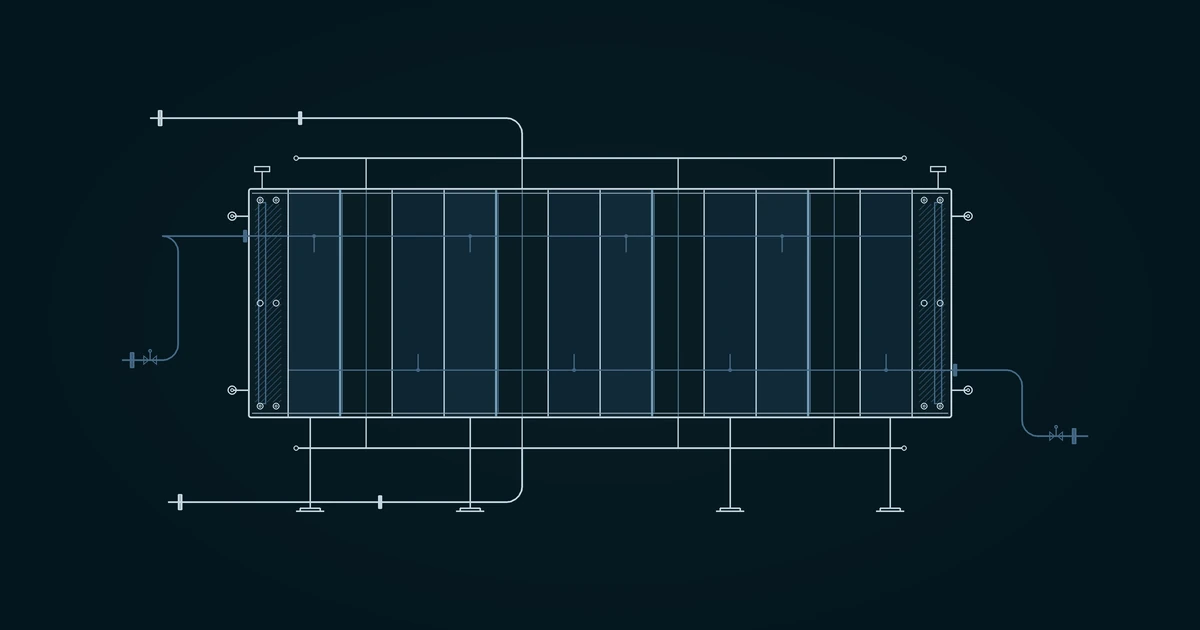
Salt is the residue every water plant pays to remove
Desalination plants worldwide produce 141.5 million m³/day of brine (Jones et al., 2019). Industrial plants add their own salt streams: sodium sulfate from fibre production, sodium chloride from metals processing, salts from organic acid fermentation.
Most of that salt is treated as waste. It goes to ponds, trucks or thermal evaporation. Brine disposal is costly and carries negative environmental impacts (Jones et al., 2019).
The same plants often buy hydrochloric acid and sodium hydroxide. Bipolar membrane electrodialysis (BPED) connects the two: it makes the acid and alkali out of the salt.
Bipolar membrane electrodialysis splits water at the membrane
A bipolar membrane (BPM) carries an anion layer and a cation layer on one sheet. Between them sits an interfacial catalytic layer. Under an electric field, water splits at that layer into H⁺ and OH⁻.
A three-compartment stack combines BPM with anion-exchange (AEM) and cation-exchange (CEM) membranes.
- Feed salt solution, such as sodium chloride or sodium sulfate, enters the central salt compartment.
- Field current drives cations through the CEM and anions through the AEM, out of the salt stream.
- Split occurs at each bipolar membrane, which supplies H⁺ to one side and OH⁻ to the other.
- Recombine follows: anions meet H⁺ to form acid, and cations meet OH⁻ to form alkali.
- Return sends the acid and alkali back into the plant, while the depleted salt stream recirculates.
No chemicals are added to make the split (MediSun membrane portfolio film). Electricity and membranes do the work. The result is acid and alkali recovery from a stream that was headed for disposal.
MediSun BPED stacks and membranes in figures
MediSun makes the stack and all three membranes. These figures come from the MediSun BPED Catalogue.
- ≤73 g/L HCl and ≤80 g/L NaOH from three-compartment stacks (MS-BPED-3C), with 50–200 membrane pairs in 400 × 800 mm and 550 × 1,100 mm formats.
- ≥0.98 transport number for the bipolar membrane, stable across pH 0–14, built in a single-step monolithic process so the layers do not delaminate.
- ≥95% to ≥98% perm-selectivity for AEM and ≥97% to 98% for CEM, with area resistance of 2.5–5.0 Ω·cm².
- 90,000 m²/year membrane production capacity, 47 national patents and a 3–5 year membrane service life.
- Up to 99% less toxic wastewater discharge in suitable applications; the figure depends on feed, recovery target and configuration and is confirmed at pilot stage.
Five industries already split salt with BPED
The MediSun BPED Catalogue lists installed and reference applications. Each one uses salt splitting to replace a waste salt with a product.
Lithium hydroxide. A salt-lake producer, Qinghai Jinzang, makes 10,000 t/a LiOH with a three-compartment bipolar system. It uses 2,500 m² of each membrane type.
Sodium sulfate splitting. A chemical fibre producer, Yibin Grace, splits 4 t/d of sodium sulfate. It produces acid and alkali at ≥8% for ≤2,200 kWh/t.
Precipitated silica. A 330 t/y line reaches ≥8% acid and alkali at ≤2,200 kWh/t.
Hypophosphorous acid. A 1,200 t/a line produces ≥10% acid and ≥5% alkali for under 1,000 kWh/t acid.
Organic acid. A biopharma skid treats 1.5 m³/h with ≥90% conversion. It cuts Na⁺ from 15,000 to 1,500 mg/L.
The same chemistry applies to desalination brine. After high-salinity RO or electrodialysis concentration, BPED can regenerate the acid and caustic a water plant uses for cleaning and pH control.
Commercial today, and the last step before evaporation
BPED is commercial. MediSun supplies stacks, membranes and lab units today. A lab BPED stack weighs 60 kg, uses 400 × 200 mm membranes, runs 10–20 pairs and draws 2 kW installed. Plant owners can test their own feed on it before scaling.
BPED is also a core component of BrineHouse, the BWRO brine treatment plant now moving to a full-process demonstration line. There it returns acid and alkali to the plant that made the brine.
A water network that makes its own chemicals depends less on the supply chain behind it.
Salt is a resource. The membrane decides which one.
Next step: To test a waste salt stream on a lab stack, contact info@medisun.energy.